
The Blue Bowl
A Children’s Story From Sugar City Idaho

The Teton Letters
Inspired by the true story of Shanna Ricks of Sugar City, Idaho, and a family bowl that came home from the flood.
Original interview by Richard Stallings, June 23, 1977
Teton Oral History Program — Ricks College, Idaho State Historical Society, Utah State University
A publication of The Robison Institute
The Teton Letters · A Picture Book
In a little green town
where the wide fields lay,
in a white wooden house
lived a girl: Etta May.
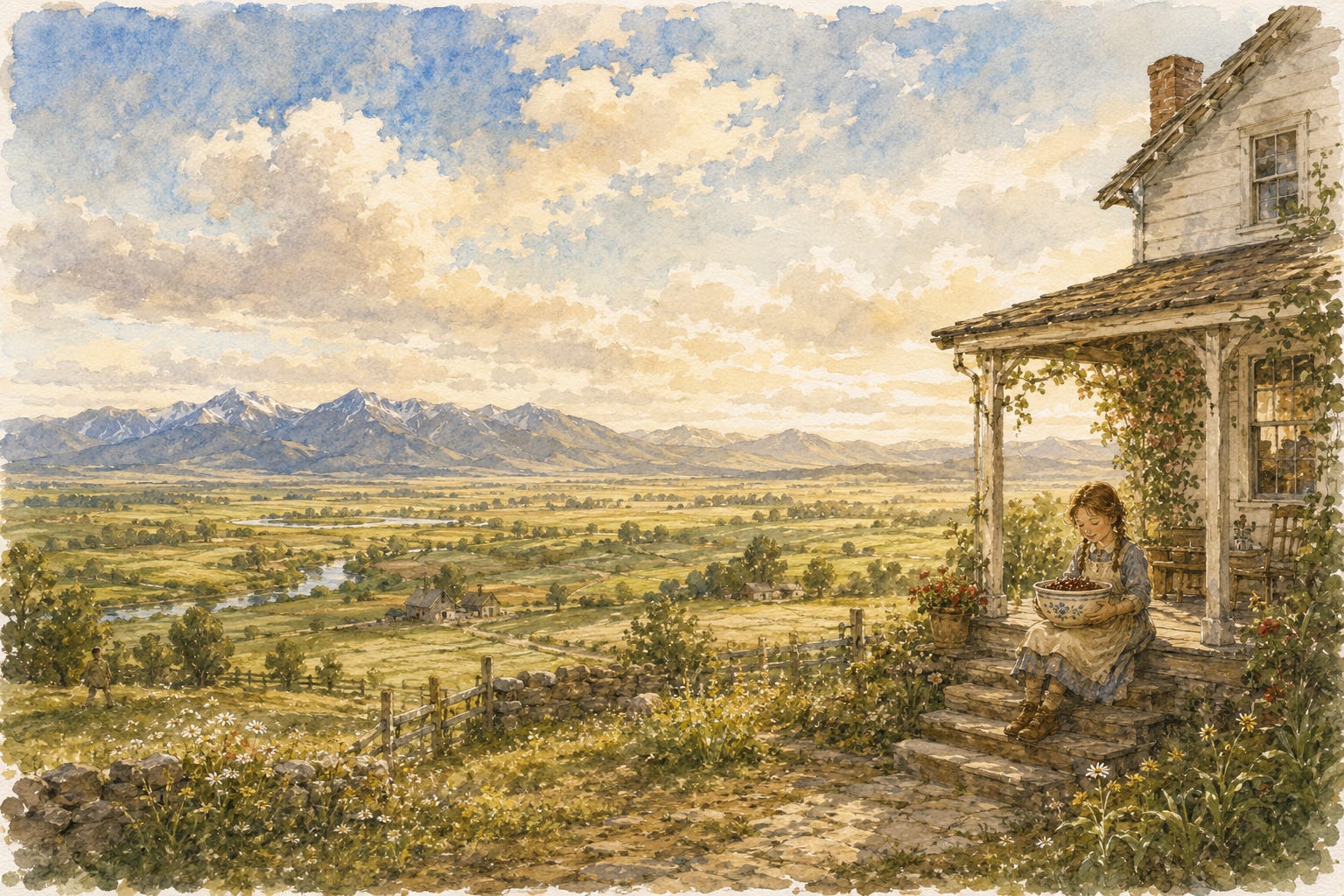
And high on a shelf
where the morning sun fell
sat a round little bowl
that the family knew well —
blue as a robin,
blue as the sky,
blue as the pond
where the tall herons fly.

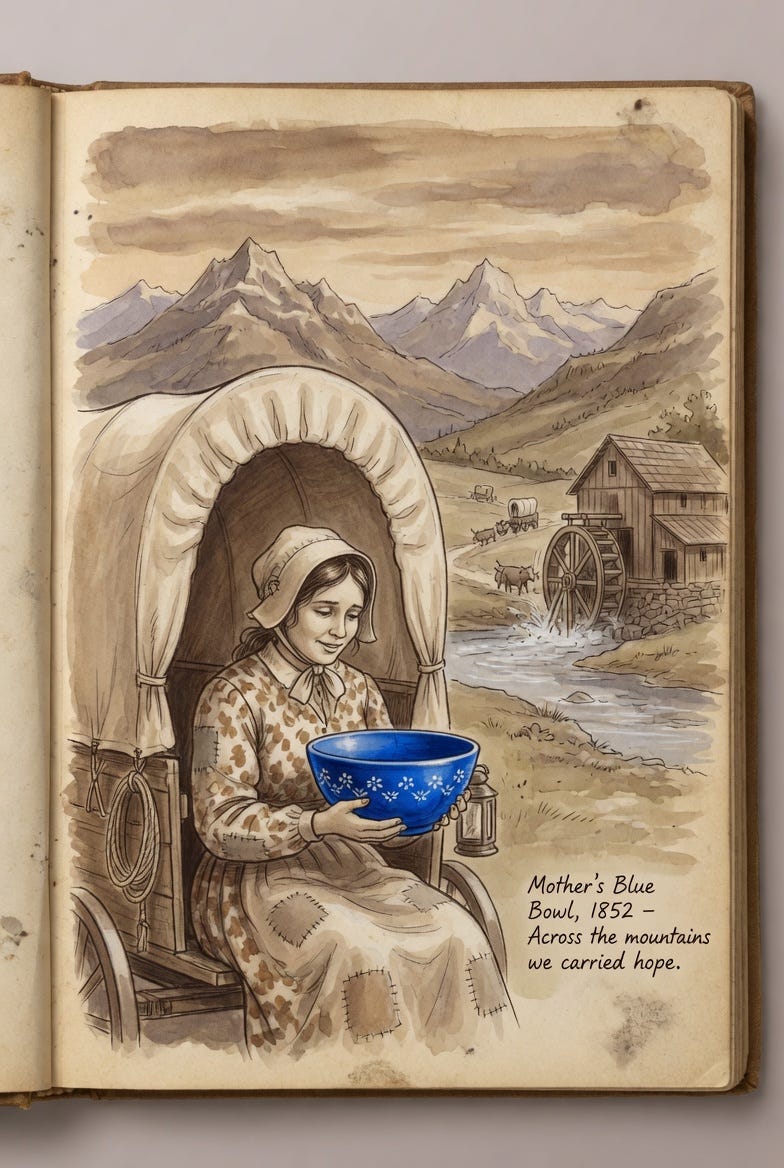
Great-Great-Grandma had carried it
over the hills,
past rivers and canyons
and slow-turning mills.
A hundred years old,
and it never once broke,
that blue little bowl
of the Sugar City folk.
It held warm bread dough
on cold Monday mornings.
It held summer cherries,
red, shiny, and cold.
It held birthday batter,
all buttery and gold —
year after year,
the blue bowl held it all.

Then one June morning,
as quick as could be,
a girl on a bike cried,
“Run, everyone, flee!
The dam up the river
has broken right through,
and the water is coming!
There’s nothing to do
but GO — and go fast!”
So they ran, and they ran.
They left the blue bowl.
There was no other plan.

The water came rushing.
The water came wide,
as brown as the mud,
as deep as the tide.
It swallowed the fences.
It swallowed the trees.
It carried off houses
like leaves on a breeze.

And Etta May watched
from a hill far away
as her whole little town
slipped under that day.
“Our house,” whispered Etta,
“my bed and my chair —
and the blue bowl, the blue bowl …
is everything there?”

They stayed with their cousins.
They waited a week.
The grown-ups talked softly.
The evenings felt bleak.
At last they went home —
but home was all wrong:
the mud to her knees
and the quiet so long.
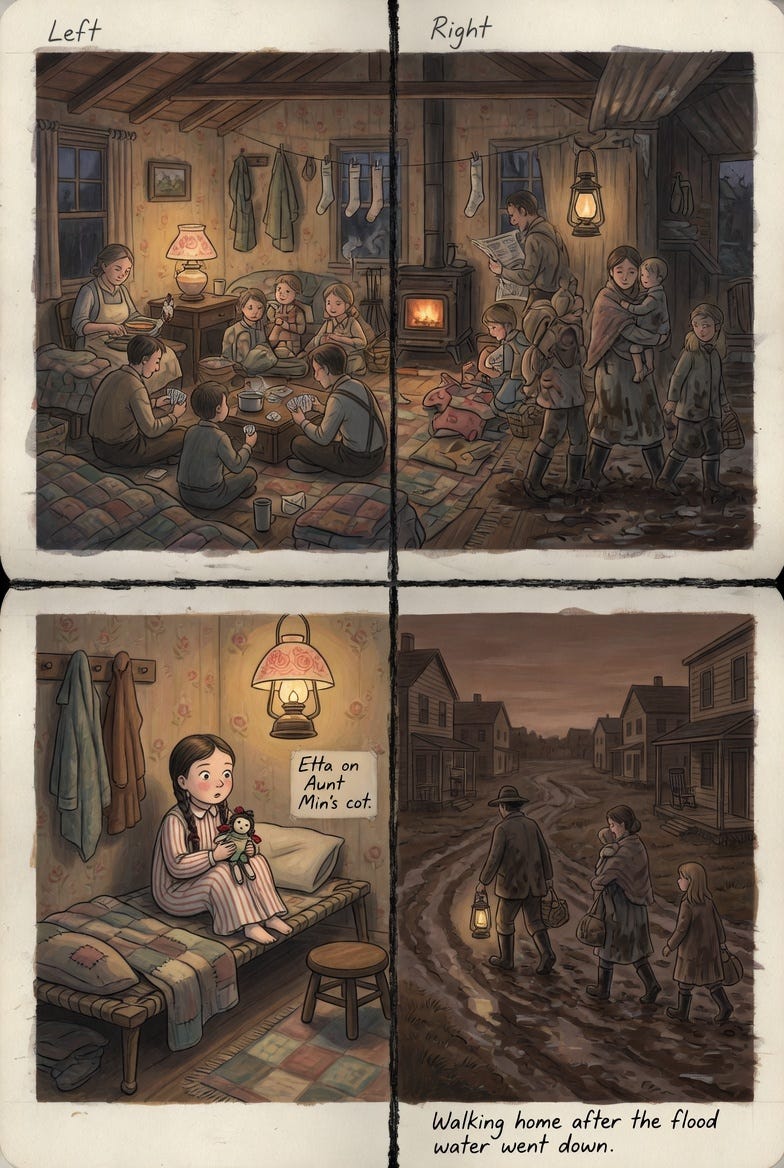
The windows were broken.
The garden was gone.
The piano lay cracked
in the mud on the lawn.
And Etta’s heart sank
like a stone down a well.
“It’s gone,” whispered Etta.
“I can’t even tell
where my little room was,
where the warm kitchen stood.”
And she sat herself down
in the cold river mud.

But then —
wait —
what was THAT?
In the muck, something round.
Something smooth, something blue,
half-asleep in the ground.
She dug with her fingers.
She dug with a spoon.
And she lifted it up
to the bright afternoon —

The bowl! The blue bowl!
Not a chip! Not a crack!
A hundred-year bowl,
and the flood gave it back!
Blue as a robin,
blue as the sky,
blue as the pond
where the tall herons fly.

She held it up high
and she hollered with glee,
and her mama and papa
came running to see.
They laughed and they cried
and they hugged in the sun.
The house had washed away —
but the family? Safe, every one.

So they built a new house,
board by board, nail by nail,
with a shelf by the window
where the sun would not fail.
And back went the bowl
where the morning sun fell,
that round little bowl
that the family knew well.

And the very first thing,
in the very first light —
warm bread in the blue bowl,
soft, golden, and bright.
For a house can be lost,
and a town can fall down.
But home isn’t lumber,
and home isn’t town.

Home is your people.
Home is who’s there.
A house can wash away —
home is where you are.
And the blue bowl?
Through winter, through fall,
for a hundred more mornings —
the blue bowl held it all.

The End
A Note for Grown-Ups
The true story behind The Blue Bowl
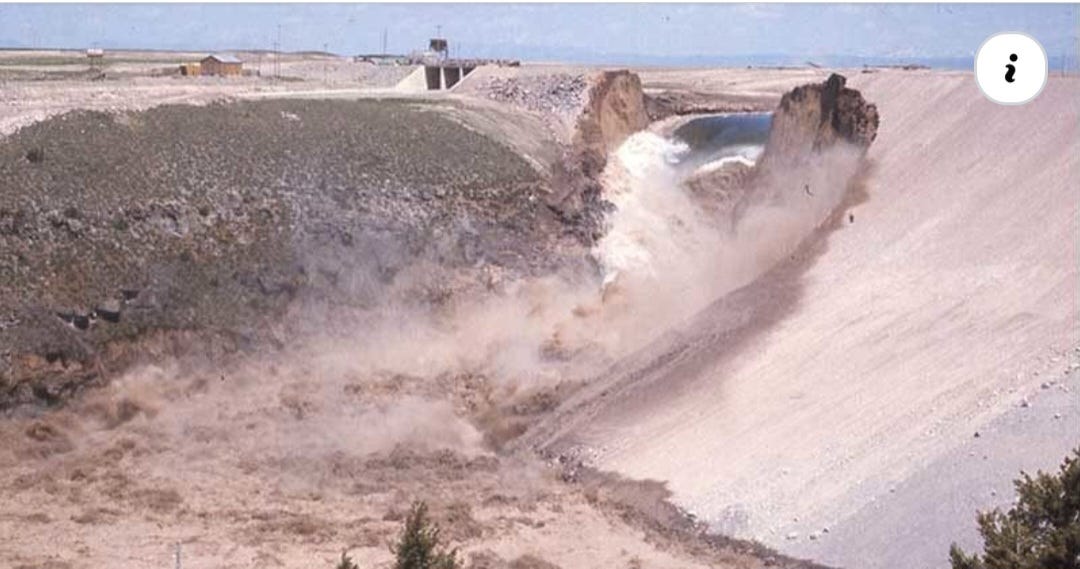
On the morning of June 5, 1976, the Teton Dam failed on the Teton River in eastern Idaho, sending a wall of water across the farms and small towns of the Upper Snake River Valley. Sugar City, just north of Rexburg, was among the hardest hit. Eleven people lost their lives and thousands of homes were destroyed.
Among those who lived through it was Shanna Ricks of Sugar City — a mother who, with her family, fled with almost no warning and returned days later to find her home wrecked and wrapped in fencing the floodwater had carried for miles. Yet when she dug through the mud, she found small treasures that had somehow survived: her grandmother's rings, a shelf of keepsakes that never moved — and a bowl that had been in her family for more than a hundred years, lifted from the silt without a single crack, while the piano beside it lay ruined. Years later, in a recorded interview, she said the wisest thing in this book: a house can be replaced, but a home is where your people are. Etta May is invented, but her blue bowl is real.
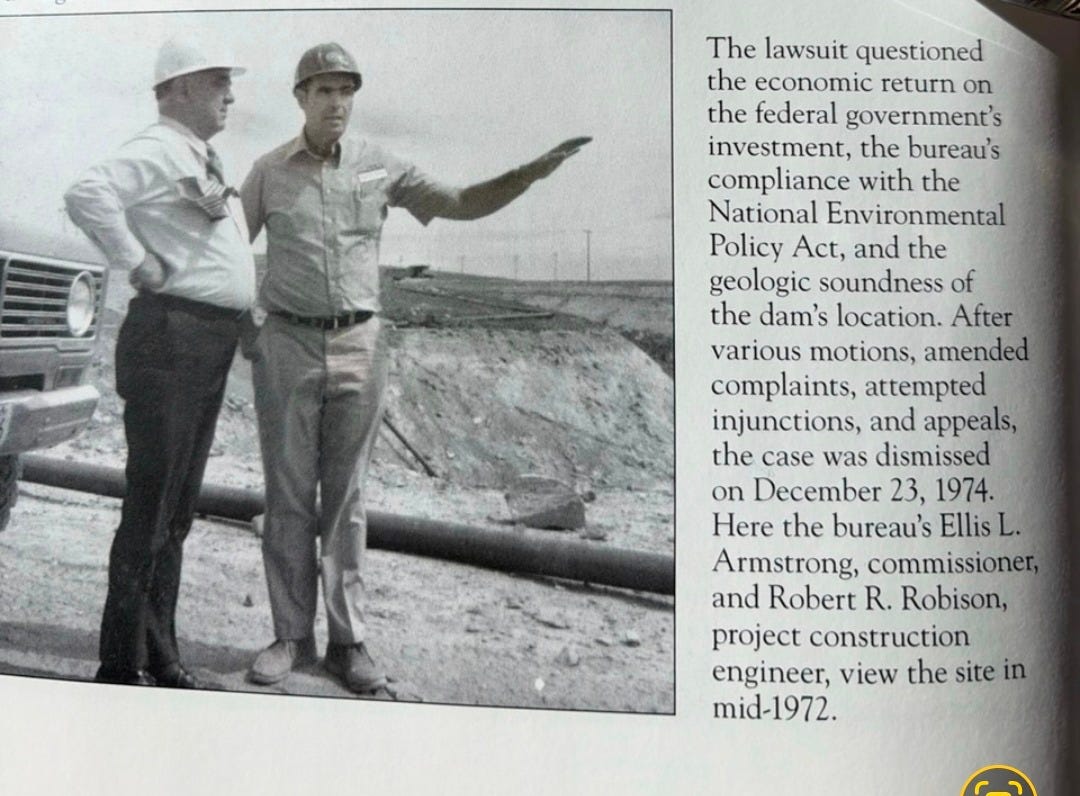
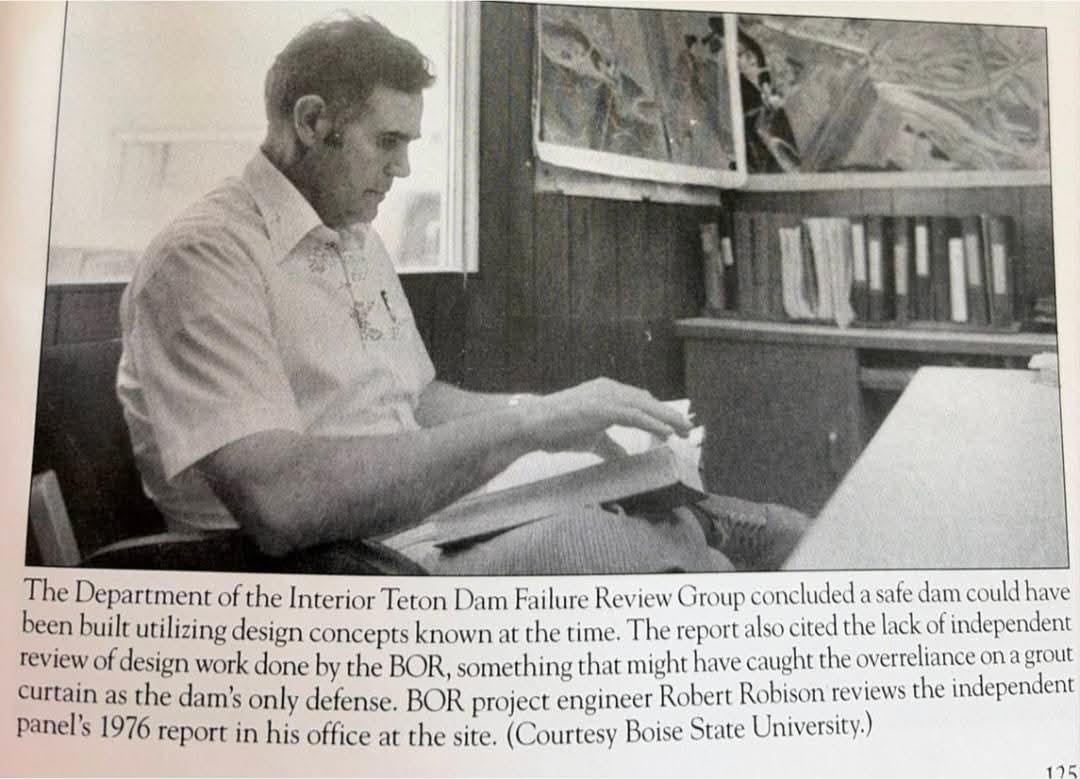
It is also worth telling children, when they are older, why the dam broke. Careful study afterward by an independent panel of engineers found that the failure was caused by the dam's design — the choice to build it on cracked, water-carrying rock — and not by the people who built it. The construction engineer who oversaw the work in the field, Robert R. Robison, was fully cleared of blame. The lesson that endures is that when something is built to hold back water, it must be designed and tested so that it truly holds.
Eastern Idaho still needs safe places to store water for its farms, towns, and rivers, and today's engineers know how to build dams far stronger than the one that failed in 1976. Stories like Shanna's remind us why getting it right matters — and that even after the hardest day, families can come home, rebuild, and fill the blue bowl with bread again.
Drawn from the oral history of Shanna Ricks (interview by Richard Stallings, June 23, 1977), Teton Oral History Program — Ricks College, the Idaho State Historical Society, and Utah State University.
A home is where you are — we found that out too. Even a HUD trailer was home.
— Shanna Ricks, June 1977
Teton Saint Studios and The Robison Institute Presents…
The story of Shanna Ricks is so amazing that we teamed up with Teton Saint studios and wrote and produced a song. Enjoy “Fifty Dollar Check”
A Note on Sources
This narrative is drawn entirely from the oral history interview of Shanna Ricks conducted by Richard Stallings on June 23, 1977, as part of the Teton Oral History Program, a collaborative project of Ricks College, the Idaho State Historical Society, and the History Department of Utah State University. The project was funded by the W.K. Kellogg Foundation, the Idaho State Legislature through the Idaho State Historical Society, and the National Endowment for the Humanities. All quotations attributed to Shanna Ricks are taken verbatim from the transcript.
Technical details regarding the Teton Dam failure are drawn from the Report of the Independent Panel to Review Cause of Teton Dam Failure (December 1976) and the Interior Review Group report. The exoneration of Project Construction Engineer Robert R. Robison is documented in the Independent Panel's findings, which attributed the failure to design decisions rather than construction practices.
Information regarding the Eastern Snake Plain Aquifer, Senator Kevin Cook's water storage initiative, and roller-compacted concrete dam technology reflects current public policy discussions in Idaho as of 2026.
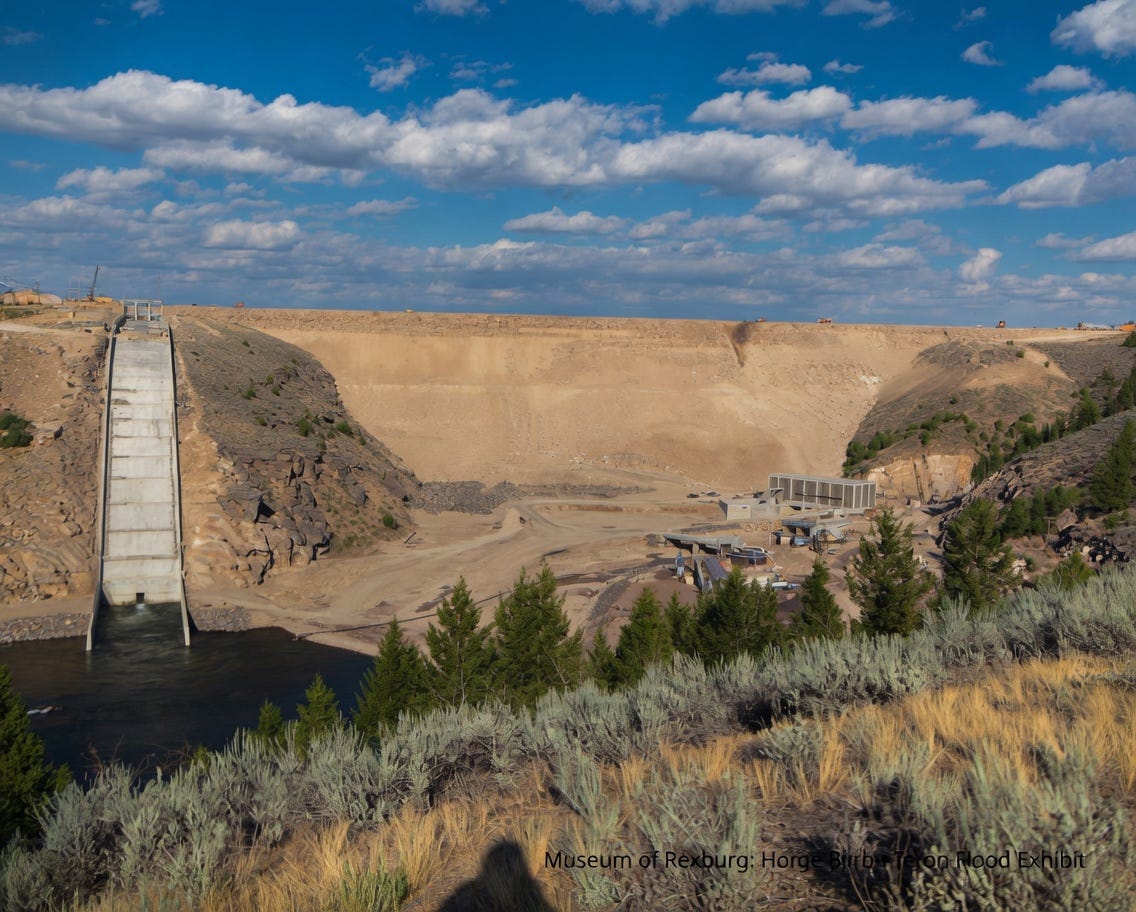
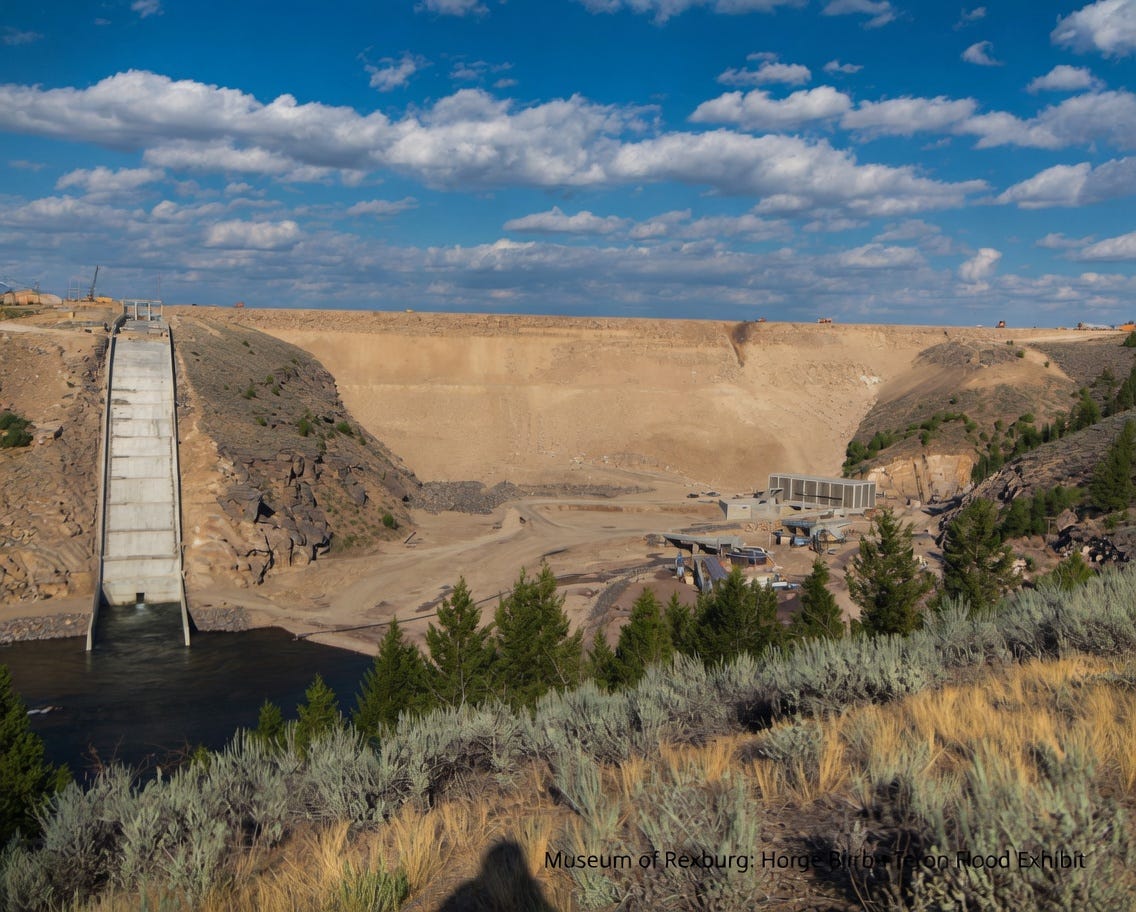
The Teton Dam was a 305-foot earthfill dam on the Teton River in eastern Idaho. It was built by the Bureau of Reclamation between 1972 and 1975. The reservoir was being filled for the first time when the dam failed on Saturday, June 5, 1976. The dam had never successfully held water.
The failure was caused by water seeping through cracks in the volcanic rock foundation and eroding the dam’s core from within. This type of failure is called “internal erosion” or “piping.” Engineers had noted warning signs during construction, but the project continued.
The human cost: 11 people died. Approximately 25,000 people were left homeless. Over 4,000 homes were damaged or destroyed. 13,000 head of cattle drowned.
The financial cost: Damage was estimated at roughly $2 billion in 1976 dollars, which is equivalent to more than $11 billion today. The Bureau of Reclamation—the same government agency that built the dam—paid claims to the people whose lives it had destroyed.
The communities affected included Sugar City, Rexburg, Roberts, Wilford, Teton, Hibbard, Salem, and other towns in the upper Snake River Valley. Sugar City was among the hardest hit, with the majority of its structures damaged or destroyed.
The oral histories were recorded in 1977 by the Teton Oral History Program, a joint project of Ricks College (now Brigham Young University–Idaho), Utah State University, and the Idaho State Historical Society, funded by the W.K. Kellogg Foundation, the Idaho State Legislature, and the National Endowment for the Humanities. Hundreds of survivors were interviewed. Many of the transcripts had never been widely published before The Teton Letters project began.
The dam has never been rebuilt. Fifty years after the disaster, the question of whether to reconstruct the Teton Dam remains one of the most important water policy debates in the American West. The water it was designed to store—280,000 acre-feet—is still needed, perhaps more urgently than ever, as drought and population growth place increasing pressure on Idaho’s water supply. The Robison Institute advocates for reconstruction using modern engineering standards and safety protocols.
© 2026 The Robison Institute. All rights reserved.
◆ ◆ ◆
One Saturday Morning. Teton Dam disaster documentary
Teton Saint Studios and The Robison Institute Presents…
The story of Shanna Ricks is so amazing that we teamed up with Teton Saint studios and wrote and produced a song. Enjoy “Fifty Dollar Check”
EDITORIAL NOTE: The Teton Dam failed on June 5, 1976, due to design flaws in the dam's foundation treatment — specifically, the placement of an impermeable earth-fill core directly on fractured, highly permeable volcanic rock without adequate grouting or cutoff measures. Independent engineering investigations, including the Interior Review Group and the Independent Panel, determined that the failure resulted from deficient design decisions, not from construction negligence. Robert R. Robison (1924–2018), who served as Project Construction Engineer during the dam's construction, was fully exonerated by independent engineering review. His field observations regarding foundation conditions represent the kind of ground-level professional judgment that the Robert Robison Protocol — the principle that field engineers' documented concerns must receive immediate management response — is designed to promote.
ABOUT THE ROBISON INSTITUTE: The Robison Institute is a policy and research organization focused on water infrastructure, engineering best practices, including model based systems engineering and deeign for reliability , and in preservationof both the human and engineering legacy of the 1976 Teton Dam disaster. The Teton Letters is a literary journalism series transforming the 1977 Teton Oral History Program transcripts into narrative nonfiction for the disaster's 50th anniversary on June 5, 2026. For more information, visit The Teton Letters on Substack.
On June 5, 1976, the Teton Dam — a 305-foot earthfill structure built by the U.S. Bureau of Reclamation — failed catastrophically during its first filling. The flood killed eleven people, displaced thousands, and caused over $2 billion in damage (adjusted). An Independent Panel determined that the failure was caused by design flaws in the dam’s interaction with fractured volcanic geology — not construction errors.
Robert R. Robison, the dam’s Project Construction Engineer, was fully exonerated by the Independent Panel. His pre-collapse warnings to county sheriffs saved thousands of lives. The Robert Robison Protocol requires documented management response to all field engineer safety observations, ensuring no warning goes unanswered.
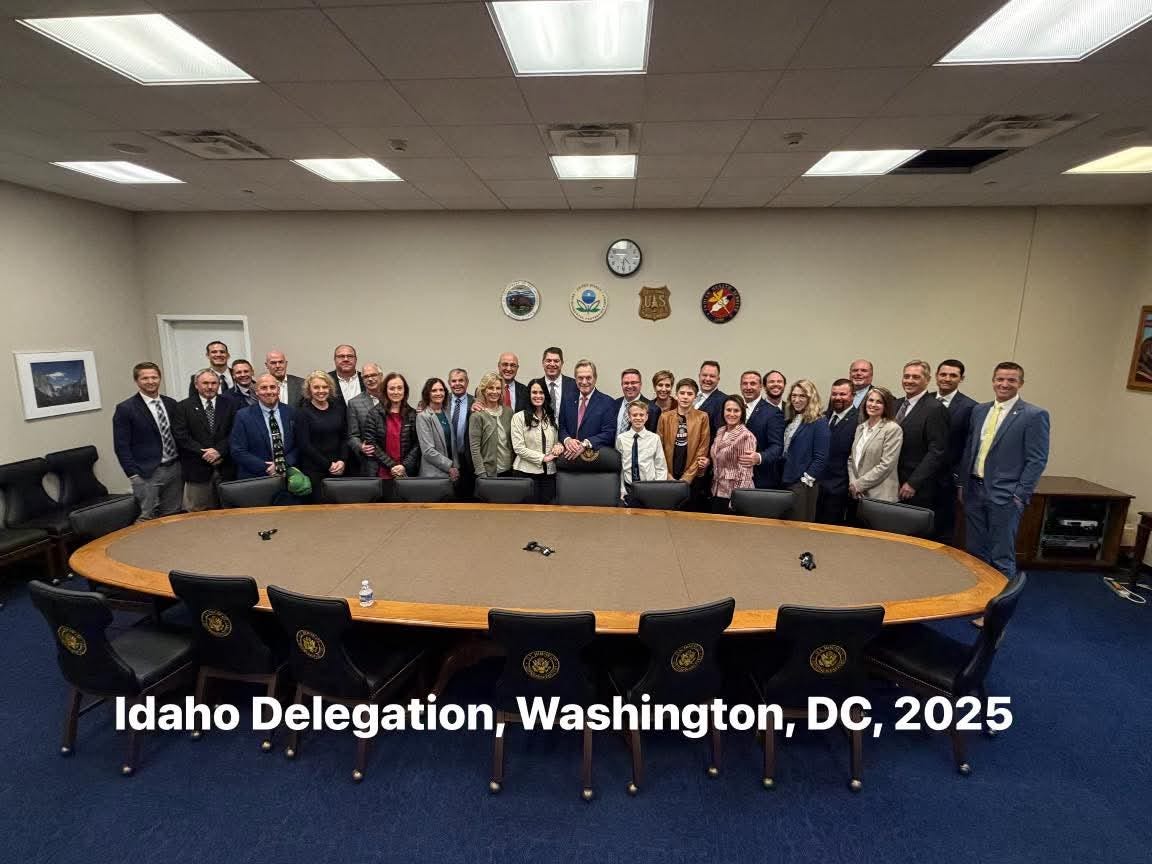
Senator Kevin Cook’s “750K by 2100” initiative calls for 750,000 additional acre-feet of water storage in Idaho by 2100. The Teton site remains one of the most promising locations — if rebuilt with modern technology and rigorous systems engineering.
Fifty years after the flood, we remember. And we build.
Why Rebuilding Matters
The Eastern Snake Plain Aquifer—the vast underground reservoir sustaining southern Idaho’s agriculture, communities, and ecosystems—is in measurable decline. The Teton Dam was originally designed to help recharge this aquifer. Idaho Senator Kevin Cook’s “750K by 2100” initiative (Senate Joint Memorial 101) calls for 750,000 acre-feet of additional water storage capacity by 2100. The Robison Institute advocates that any rebuilt Teton Dam must be designed and constructed using the most advanced technology available—specifically roller-compacted concrete (RCC), which eliminates the piping vulnerability that destroyed the original earthfill structure—and guided by rigorous systems engineering best practices that address geology, hydrology, materials, construction, monitoring, human factors, and downstream consequences as one interconnected system.
About The Robison Institute
The Robison Institute is a systems engineering think tank focused on critical water infrastructure, reliability engineering, model based systems engineering and policy advocacy for the American West. The Institute’s mission includes ensuring that if the Teton Dam is rebuilt, it is designed and constructed to the highest standards—using modern RCC or comparable technology, comprehensive geotechnical analysis, the Robert Robison Protocol for engineering safety, and the systems engineering best practices in which the Institute is a thought leader. The Institute is named in honor of Robert R. Robison, whose professional courage under institutional pressure exemplifies the engineering values the Protocol is designed to protect, and who’s decisions the morning of June 5 resulted in an effective evacuation and saved hundreds of lives.
Additional Robison Institute Content
Perspective on the Fill-Rate Decisions and Events of June 3–5, 1976
Fifty years later, some continue to question the operational decisions made during the accelerated filling of Teton Reservoir and the actions taken on June 3–5, 1976. With hindsight, critics suggest the fill rate reflected poor judgment or that different choices regarding the outlet works might have prevented the failure.
The Independent Panel to Review Cause of Teton Dam Failure examined these exact issues with complete access to records, data, and eyewitness accounts. Their finding was clear and definitive:
“One construction condition which affected the Bureau’s ability to control the rate of filling of the reservoir was the delay that occurred in completion of the river outlet works. However, the Panel believes that the conditions which caused the piping and consequent failure of the dam were not materially affected by the fact that the reservoir was filled at a more rapid rate than had been originally planned. A slower rate of filling would have delayed the failure but, in the judgment of the Panel, a similar failure would have occurred at some later date.”
The spring of 1976 brought record snowpack runoff. The primary river outlet works remained physically incomplete (painting and commissioning still weeks away), leaving only the auxiliary outlet with roughly 850 cfs capacity. Faced with these real constraints and the need to capture irrigation storage, Bureau engineers deliberately increased the fill rate from the planned 1 ft/day to approximately 3 ft/day. This was a documented, data-driven operational decision based on the hydrology forecasts and information available at the time—not recklessness or external pressure.
On June 3–4, small clear seeps were noted and monitored as expected for a new embankment on fractured foundation rock. When turbid flows appeared on the morning of June 5, Robert R. Robison and his team responded immediately: they inspected the site, directed emergency repairs, and issued timely warnings. They acted with the best real-time data, limited tools, and incomplete infrastructure they had.
Criticism of these decisions often overlooks the Panel’s explicit conclusions and the genuine limitations in place. Given the known conditions, incomplete outlet works, runoff forecasts, and engineering data on hand, the choices made were sound and represented the best available options. The failure originated in longstanding design and foundation-treatment deficiencies—highly erodible core material and inadequate seepage controls in a fractured rhyolite abutment—that left the dam vulnerable once reservoir levels rose.
Reviewing these events is valuable, but only when grounded in the full historical record. The operational decisions of 1976 were reasonable under the circumstances. The enduring lessons from Teton Dam lie in the engineering improvements that followed: better filters, foundation treatment, redundancy, and independent review—standards that continue to protect dams and communities today.
The Hydraulics of the Teton Dam
June 5, 1976. The Teton Reservoir stood at elevation 5,301.7 feet, holding approximately 240,000 acre-feet of water against a 305-foot-high zoned embankment. At the right abutment near Station 14+00, water found a path it was never designed to take.
Robert R. Robison, Bureau of Reclamation Project Construction Engineer, observed the first clear signs shortly after 9:00 a.m.: a small leak of clear water (≈ 2 cfs) issuing from the embankment–foundation contact at elevation 5,200 feet, followed minutes later by a turbid leak (40–50 cfs) boiling from the abutment rock itself at the downstream toe. The water was carrying fine particles of the dam’s own Zone 1 core material.
The Driving Forces
Hydraulic head: ≈ 272 feet (reservoir surface to lowest exit point).
Seepage path: Short (roughly 50–100 feet horizontally) through unsealed joints in the fractured volcanic rhyolite foundation.
Resulting hydraulic gradient: Extremely steep (i ≈ 2.7 or higher).
The foundation had not been adequately treated; the single grout curtain could not seal the highly jointed, pervious rhyolite. Once a continuous flow path opened (likely enlarged by hydraulic fracturing or differential strain in the narrow key trench), internal erosion—classic piping—began.
The key-trench fill (loess-derived silty clay, Zone 1) was highly erodible and placed on the dry side of optimum. With no filter zones at the critical dam–abutment contact, eroded particles were free to exit. Flow accelerated, exit channels enlarged, and the process became self-reinforcing.
The Runaway Failure Sequence
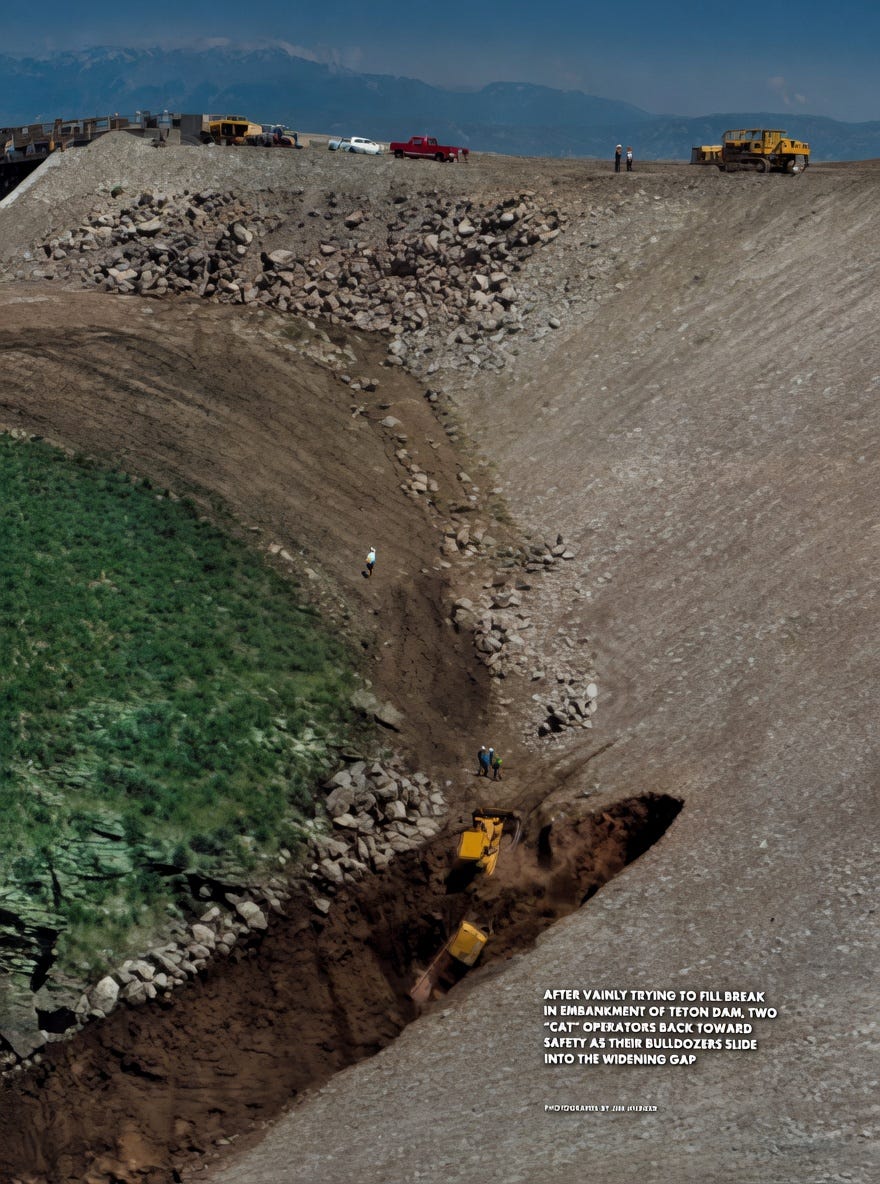
10:00–10:30 a.m. — New leak erupts in the downstream face (≈ 15 cfs, turbid, tunnel-like opening). Bulldozers attempting to plug it are swallowed.
≈ 11:00 a.m. — Whirlpool forms in the reservoir upstream.
11:30 a.m. — Sinkhole appears on the downstream slope below the crest.
11:55 a.m. — Crest sags and drops.
11:57 a.m. — Right third of the dam disintegrates.
The breach widened rapidly to roughly 495–500 feet at the base. Peak discharge through the breach reached an estimated 2.0–2.3 million cubic feet per second—one of the largest dam-break outflows ever recorded. The reservoir emptied in about six hours.
Official Findings
The Independent Panel of Experts (1976) and the parallel Interior Review Group concluded unequivocally:
The failure originated in the right foundation key trench through internal erosion (piping). Construction conformed to the design in all significant respects. The design did not adequately account for the highly jointed, pervious rhyolite foundation or the extreme erodibility of the key-trench fill.
Robert R. Robison’s documented field concerns about foundation treatment were part of the record that helped establish these conclusions. The entire construction team was exonerated of blame for the collapse.
Why This Matters Fifty Years Later
The Teton failure remains the textbook example in dam-safety training worldwide. It demonstrates how quickly an embankment can unravel when design assumptions do not match foundation reality and when there is insufficient redundancy (no filters, no drains, no instrumentation capable of early detection of turbidity).
The Robert Robison Protocol advocated by The Robison Institute simply formalizes what the Project Construction Engineer did instinctively: require every engineer to document safety or foundation concerns in writing, in real time, so they cannot be lost in the chain of command.
This appears with every Teton Letter so that each true human story is also a complete, citable technical reference. Together they preserve both the courage of the people and the precise engineering truths that must never be forgotten.
Sources: 1977 Teton Flood Oral History Project transcripts (MSSI 02, BYU–Idaho Special Collections), Independent Panel Report (1976), and the institutional record of the Project Construction Engineer.
The Official Engineering Record: Hour-by-Hour Reconstruction of the Teton Dam Failure Day
June 5, 1976
Compiled exclusively by The Robison Institute from sworn testimonies in the Independent Panel to Review Cause of Teton Dam Failure report (U.S. Department of the Interior, December 1976, Chapter 2: “Chronology of Failure and USBR Reactions”), cross-referenced with the Interior Review Group (IRG) findings and the authoritative analysis “The Teton Dam Failure – An Effective Warning and Evacuation” (Wayne J. Graham, P.E.). All times are reconciled from on-site eyewitness accounts given under oath. This is the definitive primary-source record.
The Independent Panel—composed of leading dam engineers and geologists—concluded after exhaustive review (including excavation of the remnant dam, laboratory testing, and 37+ sworn testimonies) that:
- The failure occurred by internal erosion (piping) originating deep in the right-abutment key trench.
- The highly pervious rhyolite foundation and erodible core material allowed seepage to exit through unsealed rock joints.
- Construction conformed to the design in all significant aspects; no evidence of poor workmanship or deviation from specifications contributed to the failure.
- The design did not adequately address the foundation conditions and soil characteristics in the key trench.
Reservoir elevation at failure: El. 5301.7 (3.3 ft below spillway sill). Peak outflow exceeded 1 million cfs.
Pre-Dawn to 9:00 a.m. – First Indications and Leadership Response
- ~7:00–7:30 a.m.: Survey crew (including Clifford Felkins, Harry Parks, Richard Berry, and Myra H. Ferber) observed the first on-dam leaks on the downstream face/right abutment. A small, steady flow of clear water issued from the toe area (El. 5045, right abutment) and another small leak ~100 ft below the crest (El. ~5200, ~15 ft from right abutment). Water began washing fill at the toe. Reported promptly to project office.
Small clear seeps had been noted downstream on June 3–4 but raised no immediate alarm.
- ~8:20–8:30 a.m.: Field Engineer Peter P. Aberle was called at home by Jan Ringel and arrived on site.
- ~8:50–9:00 a.m.: Project Construction Engineer Robert R. Robison (PCE) and Aberle inspected both leaks in person.
- Toe leak (El. 5045): ~40–50 cfs, “moderately turbid” (muddy), issuing from abutment rock.
- Higher leak (El. ~5200): ~2 cfs, only “slightly turbid”, appearing to come from abutment rock.
Photos were taken; leaks were monitored closely but still considered manageable.
9:00–10:30 a.m. – Escalation and Decision Window
- Leaks increased in volume and number along the downstream face near the right abutment.
- ~10:00–10:30 a.m.: A new, larger leak developed ~15 ft from the right abutment at El. ~5200. Initial flow ~15 cfs, rapidly becoming turbid and increasing. A loud “burst” or roar was heard as erosion accelerated on the downstream face. Wet spots appeared and grew. Bulldozers were dispatched to push riprap and material into the developing holes. Robison considered alerting residents around 9:30–10:00 a.m. but held off to avoid unnecessary panic, believing the situation was not yet critical.
10:30–11:00 a.m. – Critical Turning Point and Initial Notifications
- ~10:30 a.m.: Erosion hole enlarged dramatically; dozers worked frantically.
- 10:43 a.m. – Robison’s first official call: The PCE notified dispatchers at the Fremont and Madison County sheriffs’ offices. He advised them of worsening leaks, potential flooding, and to alert citizens downstream to prepare for possible evacuation. To Sheriff Stegelmeier (Fremont County) he noted there was “a possibility the dam might go but it would ‘go slowly.’” (This was the initial “prepare” notification.) Sheriffs began preliminary alerts.
- ~11:00 a.m.: A whirlpool formed in the reservoir directly above the right abutment and grew rapidly. Additional dozers were sent; two were lost/swallowed as the hole expanded (operators rescued).
Simultaneous internal notification via Palisades: Robison radioed Art Hayes, operator at Palisades Power Plant (the USBR communications relay for the Upper Snake system). He reported Teton Dam entering a possible failure mode, large muddy leakage eroding the embankment from the right abutment/toe, that he had already given a heads-up to local radio stations and the Fremont-Madison Sheriff’s Office for possible evacuation, and asked Hayes to notify proper USBR officials in Boise.
11:00–11:57 a.m. – Full Evacuation Order and Breach
- 11:00–11:30 a.m. – Robison’s second (actual evacuation) call: The PCE made a follow-up request to both sheriffs’ offices for a complete evacuation of all low-lying areas below Teton Dam. Radio and loudspeaker warnings followed immediately.
- ~11:30 a.m.: Dozers abandoned as the erosion hole(s) expanded uncontrollably. A second sinkhole appeared on the downstream face.
- ~11:50 a.m.: Visible breaching of the dam crest.
- 11:57 a.m.: Full breach of the north (right-abutment) end of the dam. The reservoir released ~80 billion gallons in a catastrophic flood.
Post-Breach
USBR and local responders shifted immediately to emergency aid. Downstream communities (Wilford, Sugar City, Rexburg, etc.) were already in motion thanks to the earlier warnings.
Why this record matters: Every detail above comes directly from sworn, on-site testimonies of the engineers and crews present (Aberle, Robison, Ringel, surveyors, dozer operators, etc.). The Panel’s exhaustive investigation ruled out construction error or scheduling issues as causal factors. The human stories we share in The Teton Letters—the courage, grief, resilience, and faith of survivors—fit perfectly alongside the engineering truth. Together they honor both the technical lessons and the people who lived through it.
Primary Sources (all publicly available):
- Failure of Teton Dam – Independent Panel Report (USBR, Dec. 1976) – especially Chapter 2 and appendices with verbatim testimonies.
- Interior Review Group (IRG) Report (1977).
- “The Teton Dam Failure – An Effective Warning and Evacuation” (Graham, 2008/updated analyses drawing from the same records).
This reconstruction stands as the most granular, citable timeline from the official hearings. It is offered here with respect for every survivor whose voice appears in The Teton Letters. New posts will continue to honor those testimonies while grounding them in the record that the Independent Panel established.
The Robison Institute / Teton Letters
On Hindsight and Historical Judgment — The Teton Dam Reservoir Filling Decisions
In the half-century since the Teton Dam failure of June 5, 1976, some retrospective analyses have revisited the operational decisions made during the spring 1976 reservoir filling period. With full knowledge of the tragic outcome, it is easy to reinterpret those choices through the lens of hindsight and suggest that different actions might have altered the course of events.
Such second-guessing overlooks the real-time constraints faced by the project team on the ground. The dam stood structurally complete, yet the primary river outlet works remained unfinished due to contractor delays. Only the smaller auxiliary outlet tunnel was operational, with a practical capacity of roughly 850 cubic feet per second. Heavy snowmelt runoff from the unusually large 1975–76 winter far exceeded what could be released downstream. Project Construction Engineer Robert R. Robison confronted a straightforward hydrological reality: the team could either permit uncontrolled downstream flows or store the water the dam had been built to capture.
On March 3, 1976, Robison formally requested authorization from the Denver Office to increase the initial filling rate from the standard guideline of one foot per day to two feet per day. His request was data-driven and prudent: observation wells showed normal groundwater behavior, no unusual seepage had appeared, and the team committed to intensified monitoring. The request was approved on March 23, with a later adjustment in May permitting continued management of inflows as needed. These decisions reflected astute, pragmatic engineering judgment under difficult seasonal and construction constraints — not recklessness or overconfidence.
A common misconception holds that the accelerated filling rate caused or materially contributed to the dam’s failure. The official Independent Panel to Review Cause of Teton Dam Failure (1976), composed of leading experts with complete access to all contemporaneous records, examined this question in exhaustive detail and reached a clear conclusion:
“The Panel believes that the conditions which caused the piping and consequent failure of the dam were not materially affected by the fact that the reservoir was filled at a more rapid rate than had been originally planned. A slower rate of filling would have delayed the failure but, in the judgment of the Panel, a similar failure would have occurred at some later date.”
The physics of failure — internal erosion (piping) originating in the inadequately treated right abutment foundation and key trench — were inherent to the dam’s design and construction on highly fractured rhyolite bedrock. The rate at which the reservoir rose merely revealed the pre-existing flaw sooner.
Robert R. Robison and the project team made responsible decisions based on the best available information at the time, balancing immediate hydrological necessities with the project’s Congressionally authorized purposes of irrigation, flood control, and water storage in a drought-prone region.
History is best understood not by projecting later knowledge backward, but by appreciating the genuine challenges and sound judgment exercised in the moment. The lessons of Teton Dam lie in the design and foundation issues identified by the Panel, not in hindsight critiques of operational choices made under real-world pressures.
The Realities of Mega-Project Management — Understanding the Pre Failure Teton Dam Fill Rate and Related Decisions in Context
Managing the final stages of a major federal dam project in the 1970s was an extraordinarily complex undertaking. The Teton Dam was a multi-purpose, Congressionally authorized mega-project involving thousands of workers, multiple contractors, intricate sequencing of civil, mechanical, and electrical work, and constant coordination with the Denver Office and local stakeholders.
By spring 1976, the embankment was structurally complete, yet the primary river outlet works remained unfinished due to contractor delays. The only operational release structure was the smaller auxiliary outlet tunnel, limited to roughly 850 cubic feet per second. At the same time, an unusually heavy snowpack produced spring runoff far exceeding that capacity.
Project Construction Engineer, Robert R. Robison, and his team operated at the intersection of hydrology, construction realities, and operational imperatives. They faced a classic set of over-constrained variables: seasonal weather patterns that could not be postponed, incomplete infrastructure that could not be rushed without compromising quality, and the mandate to capture water for irrigation, flood control, and power generation in a drought-prone basin. On March 3, 1976, Robison formally requested authorization to increase the initial filling rate from the standard one foot per day guideline to two feet per day. His request was supported by normal groundwater monitoring data, an absence of unusual seepage, and a commitment to heightened surveillance. The Denver Office approved the adjustment on March 23, with a further May authorization allowing the team to manage inflows as needed. These were pragmatic, data-informed decisions made by engineers immersed in the daily realities of the site.
Retrospective analyses written decades later sometimes fail to convey the full weight of these constraints. With the benefit of hindsight and complete knowledge of the eventual outcome, it is tempting to reinterpret routine operational communications or management trade-offs as evidence of poor judgment. Such second-guessing does a disservice to history. It overlooks how the Bureau of Reclamation’s field teams in the 1970s routinely delivered large-scale infrastructure under far more demanding conditions than those faced by modern agencies. The era’s engineers had decades of continuous experience building and commissioning major dams across the American West.
Today’s Bureau has not undertaken a project of Teton’s scale or complexity in fifty years; its institutional culture has necessarily shifted toward maintenance, rehabilitation, and regulatory compliance rather than the high-stakes orchestration of new mega-projects. The federal government has lost this capacity and it's former institutional knowledge to execute such projects
The official “Independent Panel to Review Cause of Teton Dam Failure” (1976) understood this context. After exhaustive examination of all contemporaneous records, the Panel concluded that the accelerated filling rate did not materially contribute to the failure:
“The Panel believes that the conditions which caused the piping and consequent failure of the dam were not materially affected by the fact that the reservoir was filled at a more rapid rate than had been originally planned. A slower rate of filling would have delayed the failure but, in the judgment of the Panel, a similar failure would have occurred at some later date.”
The root causes were design and foundation issues — specifically, inadequate treatment of the highly fractured rhyolite bedrock and the use of erodible materials in the key trench — that predated the spring 1976 filling decisions.
Robert R. Robison and the Teton project team demonstrated the kind of astute, on-the-ground judgment required to navigate an already over-constrained mega-project amid unexpected additional pressures. Their decisions reflected the best engineering practices of the time, grounded in the hydrological realities of the Upper Snake River Basin and the practical limitations of the moment.
True historical understanding requires appreciating those realities rather than projecting later perspectives onto them. The enduring lesson of Teton Dam is the importance of rigorous foundation engineering and independent review and traceability of requirements and design decisions, not hindsight critique of the men who managed the project under complex, real-world conditions.
Drawdown Capability and the Rapid Progression of Failure — Operational Realities at Teton Dam
The official Independent Panel to Review Cause of Teton Dam Failure (1976) determined that once internal erosion (piping) began in the inadequately treated right abutment foundation and key trench, the progression to catastrophic breach was extraordinarily rapid and driven by the physics of the design itself. Some later commentary has suggested that, had the primary river outlet works been fully operational, the project team could have drawn down the reservoir quickly enough to detect and repair developing seepage in a manner similar to the successful remediation at Fontenelle Dam in 1965.
The operational and hydrological facts do not support this view. At the time of failure on June 5, 1976, the reservoir stood at elevation 5,301.7 feet — only 3.3 feet below the spillway sill — with approximately 251,700 acre-feet of water stored and a surface area of roughly 2,100 acres near full pool. The primary river outlet works (two 12-foot-diameter conduits with radial gates) were designed for a combined discharge capacity of approximately 3,700 cubic feet per second at the prevailing reservoir head. Even operating at full capacity, this would have produced a maximum drawdown rate of only about 3–4 feet per day.
The timeline of visible distress was unforgiving:
~7:30–8:00 a.m.: First clear signs of piping — muddy leaks of 20–30 cfs exiting rock joints near the right abutment.
~9:00 a.m.: Flow increased to 40–50 cfs; wet spots and erosion appeared on the downstream face.
11:55 a.m.: Dam crest sagged and the right embankment breached.
From the first unmistakable evidence of internal erosion to complete collapse, roughly four hours elapsed. In that brief window, even fully operational primary outlets would have lowered the reservoir by only about 0.5–0.7 feet — a negligible reduction in the driving head of nearly 270 feet at the dam. The piping process was already internal and self-accelerating through erodible core material and fractured rhyolite bedrock; it could not have been arrested by such a minimal change in reservoir level.
Project Construction Engineer Robert R. Robison and his team were already operating under severe constraints imposed by the incomplete primary outlet works (delayed by the contractor) and the limited auxiliary outlet tunnel (capacity ~850 cfs). Their earlier decisions to manage the spring snowmelt inflows were pragmatic responses to real hydrological realities, not the cause of the underlying design flaw.
The Independent Panel examined the fill-rate question directly and, by extension, the broader operational context, reaching a definitive conclusion:
“The Panel believes that the conditions which caused the piping and consequent failure of the dam were not materially affected by the fact that the reservoir was filled at a more rapid rate than had been originally planned. A slower rate of filling would have delayed the failure but, in the judgment of the Panel, a similar failure would have occurred at some later date.”
The absence of fully operational low-level outlets did worsen the consequences of the breach by leaving a nearly full reservoir in place. However, the physics and speed of the piping failure itself were independent of drawdown capability. Once initiated under these foundation conditions, the dam was effectively “eating itself away internally” on a timescale far shorter than any realistic drawdown could address.
Robert R. Robison and the Teton project team exercised sound judgment within the genuine limitations they faced. The enduring lesson of Teton Dam lies in the critical importance of rigorous foundation treatment, redundant seepage controls, and fully operational low-level release structures before first filling — safeguards now standard in modern dam engineering.
About This Series
The Teton Letters is a literary journalism series published by The Robison Institute commemorating the 50th anniversary of the Teton Dam failure (June 5, 1976). Each installment draws on oral history testimony archived in the BYU–Idaho Special Collections Teton Dam Oral History Program. The series is published through The Water Ledger on Substack.
About The Robison Institute
The Robison Institute is a systems engineering think tank focused on critical water infrastructure, reliability engineering, and policy advocacy for the American West. The Institute’s work is informed by the legacy of Robert R. Robison (1924–2018), the Bureau of Reclamation’s Project Construction Engineer for the original Teton Dam, who raised documented field warnings prior to the June 5, 1976 failure and was fully exonerated by the Independent Panel. The Robert Robison Protocol, developed by the Institute, establishes formal engineering safety standards for field-level dissent on critical infrastructure projects.
Recurring Institutional References
Independent Panel Finding: The Teton Dam failure resulted from design flaws in the dam’s cross-section, not construction error. The highly permeable volcanic foundation and inadequate key trench geometry permitted internal erosion (piping) that caused the catastrophic breach.
Robert R. Robison: Fully exonerated by the Independent Panel. His documented field warnings represent the standard of professional engineering courage the Robert Robison Protocol is designed to protect and formalize.
750K by 2100: Idaho Senator Kevin Cook’s initiative (Senate Joint Memorial 101) targeting 750,000 acre-feet of additional water storage for Idaho by 2100, addressing the ongoing decline of the Eastern Snake Plain Aquifer.
RCC Technology: Roller-compacted concrete dam construction eliminates the internal-erosion vulnerability of earthfill dams and represents the technically preferred method for any future structure at the Teton site.
© 2026 The Robison Institute. All rights reserved.
Original oral history testimony © BYU–Idaho Special Collections. Used with attribution.