
The Channel He Cut
Ray Willis Walker and the Long Quiet Politics of the Teton Dam

A TETON LETTER · BONUS EDITION
BY THE ROBISON INSTITUTE
Half a century before the Bureau of Reclamation placed the first bucket of fill into the Teton canyon, a farmer named Ray Walker decided the river on his land was wrong, and corrected it. The dam was that correction at scale. The failure was the river’s answer. The argument is not yet finished.
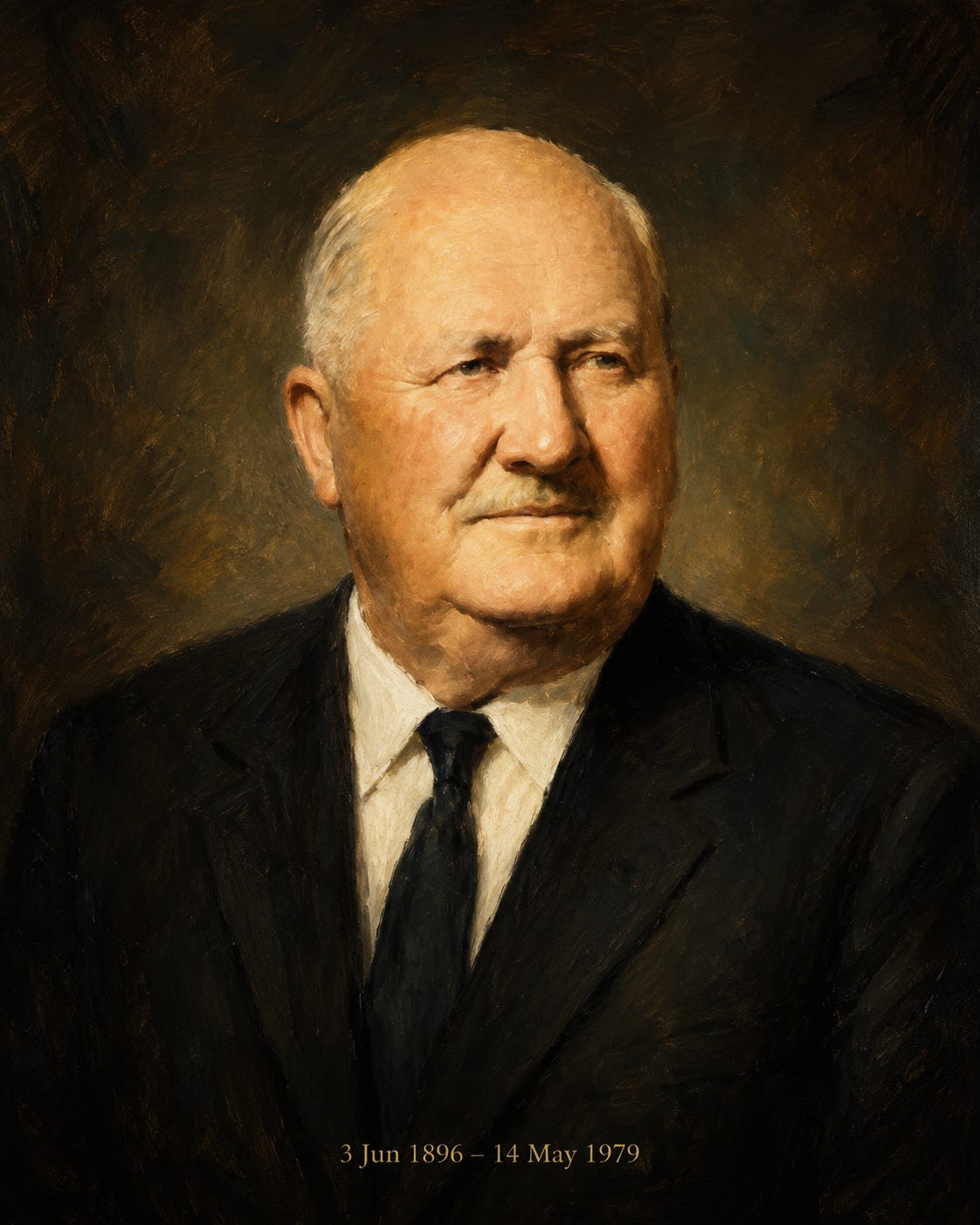
The Straightened Channel
There is a story they used to tell in Rexburg about a man who corrected a river.
The man was Ray Willis Walker, born in 1896 in the small Mormon settlement of Labelle, on the great irrigated fan of the Upper Snake River Valley. He came up on a farm and stayed on a farm — substantial acreage, eventually, fronting on the Teton River north and east of Rexburg, the kind of bottomland a farmer either learns to love or learns to leave. Walker stayed. The river he stayed with was a working river: cold and clear in good years, in flood every few springs, eating bank and crop and fence with the indifference of something older than property law.
By the time Walker was in his thirties, the Teton had carried off enough of his hayfield that he decided the river’s chosen course was, on his land, mistaken. He brought a team and a blade and he straightened it. Where the channel had bent, it now ran direct. The water, for a season at least, accepted the correction.
This is the act on which the rest of the story turns. A man can take a shovel to a river only if he has first taken something more serious to himself — a conviction that the geometry the water has chosen is wrong, and that his judgment is right enough to do something about it. Most farmers along the Teton accepted the river. Walker did not. Out of that small, stubborn refusal grew a half-century of politics, a federal dam, eleven funerals, and an unfinished argument about what the Upper Snake Valley owes itself.
The dam was Walker’s correction at scale. He did not engineer it. He did not pour it. He did something more elemental than either: he kept it from being forgotten.
Labelle
The Upper Snake in the year of Walker’s birth was not yet a finished place. Labelle was a cluster of farms north of Rigby, the kind of settlement that appeared on early plat maps and faded from later ones, absorbed by larger names. The land was lava plain disguised as soil — basalt under a few feet of windblown loess, the residue of Pleistocene floods larger than imagination.
The Snake ran cold from the high country, dropped through the valley in a great curve, and disappeared into the western desert. Where men had brought water out of the river onto the bench, the bench grew potatoes and beets and alfalfa. Where they had not, it grew sage.
Walker grew up inside the irrigation. His great-grandfather’s generation had dug the first ditches in Utah and brought the technique north into Idaho. The work was hand work — pick, shovel, scraper, mule. The water came when you opened a head gate and stopped when you closed it. The ditches froze in November and ran again in April, and a farmer’s year was the year of the water.
A boy who grows up that way does not learn to think of water as scenery. He learns to think of it as a tool that occasionally turns into a weapon. The Teton, which gathered its strength in the high country between the Tetons proper and the Big Hole range, was both. It ran the wheel of the country in July and tore the country apart in May. Walker would have watched it do both before he was ten years old.
The District
In 1935 the farmers of Fremont and Madison and Teton counties did what farmers had been doing for fifty years on the irrigated West: they organized. The Fremont–Madison Irrigation District was created to hold storage rights, to assess its users, to build and operate reservoirs, and — though it was rarely written down quite this way — to apply continuous, patient, multi-decade pressure on the federal government for additional water.
The district was an institution of remarkable practical seriousness. It built Island Park largely on the strength of its own members’ notes. It pushed Grassy Lake and Cross Cut to completion. Long before the Teton Dam was a federal line item, the Fremont–Madison farmers had demonstrated that they could finance, build, and operate substantial water infrastructure. This is a point that gets lost in the standard tellings of the Teton story, which tend to depict the dam as a thing done to a passive valley by an over-aggressive Bureau. The valley was not passive. The valley had been doing this work for a generation.
Walker came onto the district board as secretary — the office that holds the files. He moved up to president, then chairman. He stayed at the work for most of his adult life. By the time he was an old man he had served the district for so long that his name was inseparable from it. Cy Young, who worked alongside him through the 1960s and 1970s, would say in a 1980 oral history that Walker “needs no introduction to the irrigators of the Upper Snake River Valley,” and then added, more quietly: that he had worked with Walker on irrigation problems delightfully many times.
That word — delightfully — is worth pausing on. It is not the word a reluctant ally chooses. It is the word a man uses when he has spent his life in the same room as another man and would do it again.
The Long File
The Lower Teton Division was first proposed in earnest in the 1930s. Congressman D. Worth Clark made the appropriate noises. Nothing came of it. In the 1940s the war absorbed everything. In the 1950s the Bureau of Reclamation studied and re-studied. The valley’s farmers, who could read the political weather, sent their letters and waited.
Walker’s papers, preserved as MSSI 30 in the BYU–Idaho Special Collections, are the working record of those waiting years. There is a Teton Dam File. There are Lower Teton Division reports from 1963 through 1967. There is correspondence with Governor Robert Smylie, with the Department of the Interior, with members of the Idaho congressional delegation. There are proposals, water-distribution analyses, drafts of testimony. None of it is glamorous. All of it is necessary. Political ambition usually dies of inattention; Walker’s did not, because Walker did not stop sending letters.
If you want to understand how a federal dam actually gets authorized, this is the answer that no Washington insider memoir will give you. It gets authorized because a farmer in Rexburg keeps a filing cabinet for forty years.
June 1962
By 1962 the Lower Teton Division bill had passed the Senate and stalled in the House Committee on Interior and Insular Affairs. The committee was the customary graveyard for Western reclamation: not openly hostile, just slow, just busy with other things. The bill sat.
The Teton River, that spring, was not sitting. It was in flood. From the canyon downstream through the bottoms north of Rexburg the water came out of bank and stayed out, drowning hay and fence and road, doing the same work it had done in 1894 and 1909 and 1927 and every other wet year in Walker’s memory. The timing was, by accident or by providence, the kind of timing a political organizer can use.
The Fremont–Madison District chose six men to go to Washington. J. C. Siddoway was district chairman and the formal head of the delegation. Walker, as the operating force on the project, was its working leader. The others were Cy Young, Marvin Myers, Andy Anderson, Orville Mortenson, and LaRue Frandsen — farmers, all of them, with the particular shoulders and certainties that a working farm gives a man by his fifties. They flew east. None of them, probably, was much accustomed to flying.
What happened in the committee room is preserved in the public hearing record and in Young’s oral history. The delegation testified. They were helped, in the way small delegations are sometimes helped when their cause crosses the right interests, by the attorney for Utah Power and Light, who had his own reasons for wanting the bill freed. A ranking member of the committee rose to endorse the project as one with “all the good phases that a project should contain”: reclamation, irrigation, flood control, power, fish and wildlife. The committee released the bill. It went to the floor. The 1962 session ended before final action, but the lock had been picked.
Walker came home and went back to work. Authorization would not come until 1964, and appropriations would be delayed by Wayne Aspinall and a half-dozen smaller obstacles for years after that. None of that mattered in the way that the 1962 trip mattered. The bill had been moved. After thirty years of moving nothing, Walker had moved a bill.
“R. Willis Walker is recognized as sort of the father of the Teton Dam.” — Cy Young, oral history, November 22, 1980.
The hedging — sort of — is the kind of qualifier that Idaho irrigators put around statements they consider obvious. It means: of course he is. We are not the people who say so out loud, but of course he is.
The Wait
Authorization arrived in September 1964. Construction did not begin until 1972. The intervening years are the part of the story no one tells. They are the years of Wayne Aspinall’s chairmanship of House Interior and Insular Affairs, of national budget pressure, of slowly rising environmental opposition, of fights over the Columbia River Treaty and the Central Arizona Project and a dozen other things that pushed the Teton further down the list. Walker, by now in his late sixties and early seventies, kept writing.
He also began to defend. The intellectual case against the project — geological, ecological, fiscal — was beginning to be made. Walker had answers ready. He cited the Bureau’s benefit-to-cost ratio of 1.23 to 1. He cited an annual benefit projection in excess of $4.7 million. He cited the flood damages of every wet year on record. He was not, by training, an economist. He was a man who had spent fifty years watching the Teton take crops out of his neighbors’ fields, and he was making his argument from that.
The Symposium
In the early summer of 1972, with construction now underway in the canyon, a symposium on the Teton Dam was held at Idaho Falls. Walker spoke. The transcript is part of his papers. He defended the numbers. He defended the project. He pushed back on what he saw as a misreading of the valley’s needs by people who did not live in it. He was seventy-six years old. The dam he had spent his adult life arguing for was being built three miles north east of Newdale, and he had lived to see it happen.
It is worth saying clearly, because the standard narrative of the failure tends to obscure it: the case Walker was making in 1972 was substantively correct. The Upper Snake Valley needed additional storage. It still does. The 1.23-to-1 ratio was defensible. The flood damages were real. The geological hesitations that some of the consulting engineers had raised about the canyon abutments were not hesitations Walker was equipped to evaluate, and they were not the hesitations he was being asked to defend. He was defending the need. He was right about the need.
June 5, 1976
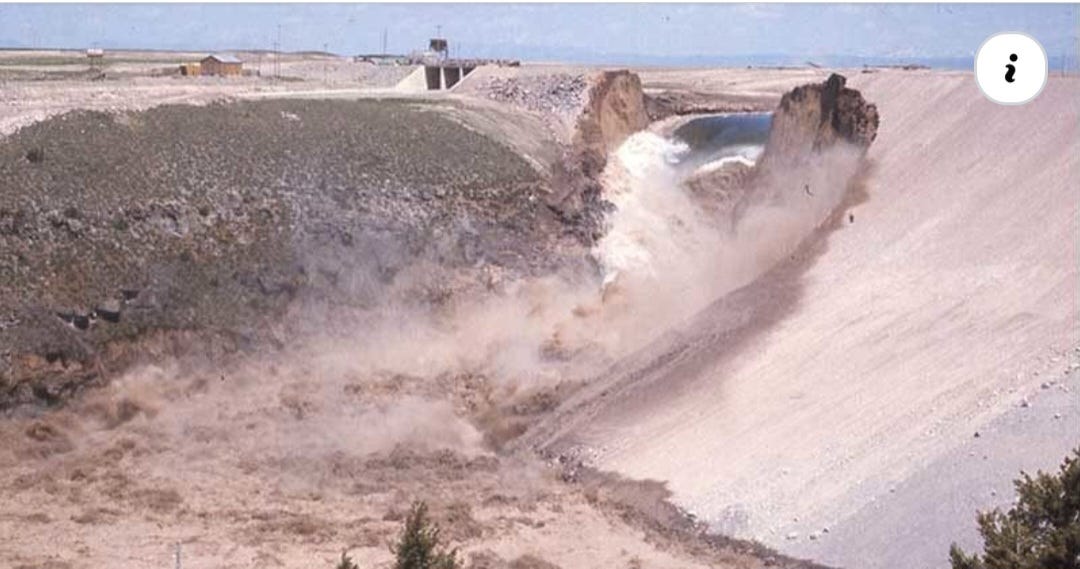
The Teton Dam failed on a Saturday morning. The structure was complete; the reservoir was filling for the first time, but it was not yet at full pool. A leak appeared on the downstream face shortly after seven o’clock. By a little before noon the right abutment had cut away and the reservoir had begun to unload. The eighty billion gallon wall of water that came down the canyon and out across the valley below carried away farms, towns, livestock, and eleven lives. Rexburg went under. Sugar City went under. Roberts went under. Wilford no longer existed in any practical sense by the end of the afternoon.
Walker was eighty years old. He was almost certainly at home in Rexburg when the water came. His own land was in the flood path. The river he had once corrected with a team and a blade was now, by the failure of the structure he had spent his life advocating, returning across his property at flood-of-record scale.
There is no oral history I have found in which Walker describes what he felt that day. He was not a man inclined to public reflection. The closest the record comes is a remark, later, when an interviewer asked him whether the failure had changed his view of the project. His answer was four words.
“We need that water.”
The Verdict
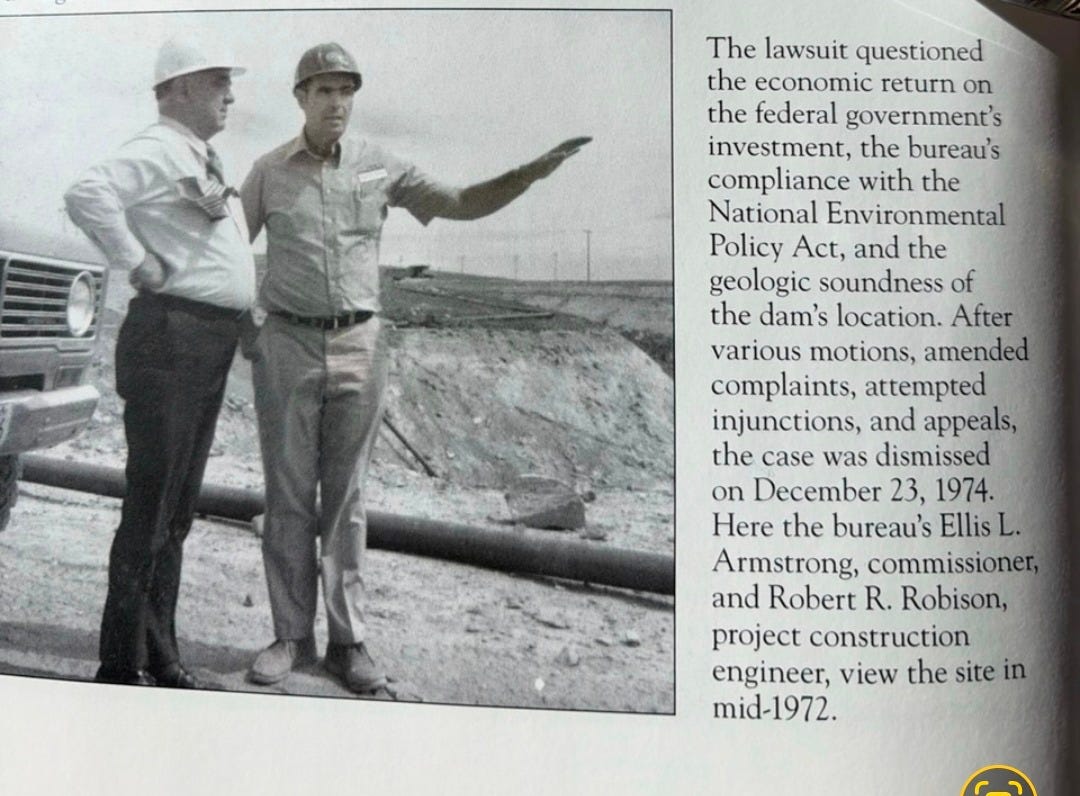
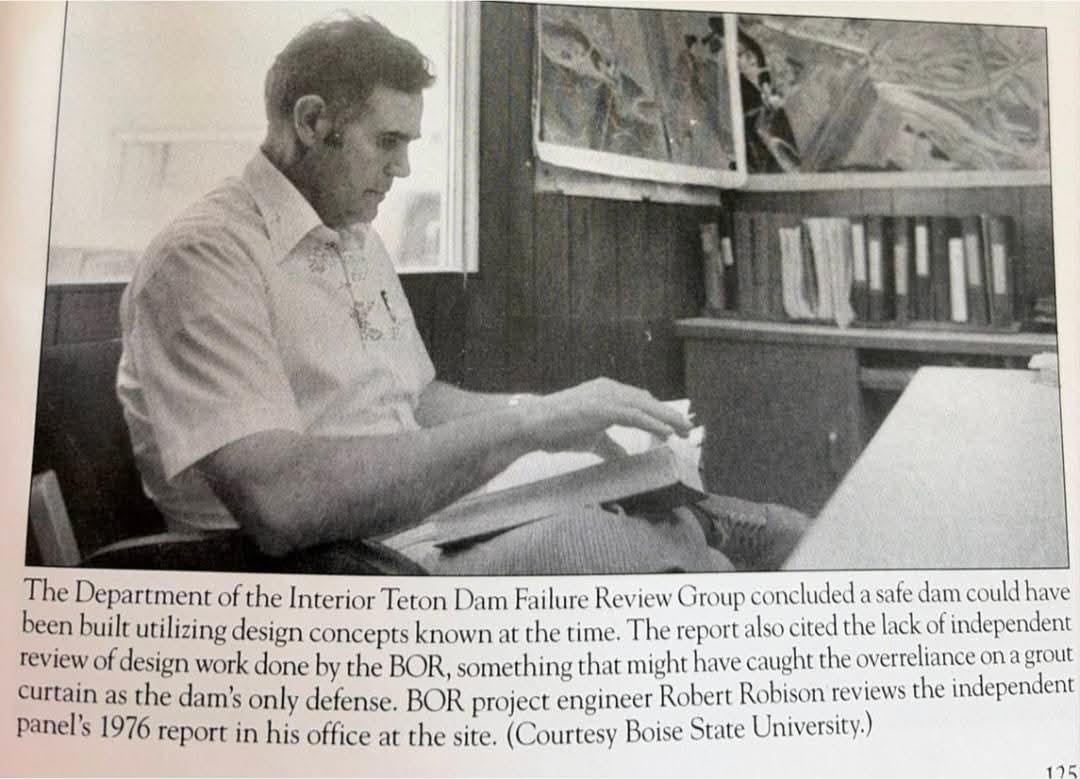
By the end of 1976 the Independent Panel had completed its review. Its finding was specific, and it has been confirmed by every serious technical examination conducted in the half-century since. The failure was not a failure of construction. The Bureau’s people on the site, including the Project Construction Engineer Robert R. Robison, had built the dam the Bureau had designed. The design itself was the problem: a fill embankment carried across rhyolite abutments more permeable, more deeply fissured, and more dangerous than the design had assumed. Internal erosion through the key trench, piped by water finding its way through abutment rock that the grout curtain could not seal, brought the structure down.
Robison was fully exonerated. So were the field crews. The men who had argued for the dam — Walker first among them — had argued for a project the engineering profession of 1972 was, in hindsight, not quite ready to build at that site by that method. That is not the same thing as having been wrong about the need. The Independent Panel did not find that the valley did not need the water. It found that the means used to deliver it had been mistaken.
The distinction matters. It is the difference between an argument refuted and an argument unfinished. The Robison Institute carries the protocol that bears its namesake’s name precisely because that distinction was insufficiently honored in the years after the failure: every field-engineer observation about safety deserves a documented management response, and the absence of such a protocol in 1976 is one of the reasons the record is still being repaired.
“We Need That Water”
Walker lived three more years. He died in 1979. The Lower Teton Division was never formally deauthorized for replacement. It remains authorized under the original 1964 congressional legislation (Public Law 88-583, signed September 7, 1964). The canyon was left as the canyon, with the wing walls still in place and the abutments still cut. Other projects, in other valleys, got other money. The Upper Snake Valley went back to relying on Island Park and Palisades and Jackson Lake and the great underground reservoir of the Eastern Snake Plain Aquifer, which had been recharged for a century by surface irrigation that the Teton, had it stood, would have multiplied.
By the second decade of the new century the aquifer was in measured decline. The water table under the valley had dropped tens of feet in places. Springs that had run for generations were running smaller, or not at all. The state of Idaho began, in slow institutional fashion, to do what Walker had been doing alone in the 1940s: to keep the file alive. Senator Kevin Cook’s Senate Joint Memorial 101 set a target of 750,000 additional acre-feet of storage by the year 2100. The number, in the strictest engineering sense, is the long-run obligation Walker would have recognized. The technology has changed. Roller-compacted concrete, a method not available to the Bureau in 1972, can now do at the Teton site what fill could never do. The geotechnical methods available in 2026 are not the methods that were available in 1972.
Walker was right about the need. The Bureau was wrong about the design. The argument is not finished.
The Channel Remembers
The straightened channel is still visible on the old Walker land north of Rexburg. From the air it appears as a stretch of the Teton that is unaccountably geometric — a straight reach in a river that everywhere else braids and bends. The river accepted the correction, in the sense that the water now runs where Walker told it to run. Whether that acceptance is permanent is a question the river will answer in its own time. Rivers are patient. They remember their old beds. The geometry that Walker imposed in the 1920s holds because, so far, the water has chosen to let it hold. That is the truthful way to describe the situation.
The same is true of the larger correction. The dam Walker spent his life arguing for was built and it failed. The need it was built to meet did not disappear with it. The valley still wants the water. The aquifer still falls. The river still floods in wet years and runs thin in dry ones. The Institute that bears the name of the engineer Walker’s project unjustly damaged — Robert R. Robison, exonerated in fact and underdescribed in the public memory — exists, in part, to make the case that Walker’s underlying argument was not refuted in 1976. It was deferred.
To call Ray Willis Walker the father of the Teton Dam is to say a true thing about the past and an incomplete thing about the future. He was the father of the Teton Dam. He may also turn out to have been the father of something that has not yet been built. The Upper Snake Valley has a way of returning to its arguments. Walker, who returned to his for forty years without raising his voice, would not be surprised.
SOURCES
• James Cyrus Young, A History of Irrigation in Fremont, Madison, and Teton Counties. Oral history #79, MSSI 50, interviewed by Harold Forbush, November 22, 1980. BYU–Idaho Special Collections.
• Theo Charles Fullmer, Teton Dam Oral History Program transcript, MSSI 02, interviewed by Alyn B. Andrus, September 18, 1977. BYU–Idaho Special Collections.
• Ray Willis Walker Papers, MSSI 30, BYU–Idaho Special Collections — including the Lower Teton Division reports (1963–1967), Teton Dam File, correspondence with Governor Smylie and the Department of the Interior, and the Idaho Falls Teton Dam Symposium transcript (June 2, 1972).
• Independent Panel to Review Cause of Teton Dam Failure, Report to the U.S. Department of the Interior and the State of Idaho (December 1976).
• 2005 BYU–Idaho student history paper on the Teton Basin Project (“spawning salmon in a spill way” characterization).
The Robison Institute · Robison Legacy Engineering LLC
Flood 50 · Teton Dam Commemoration, June 5, 2026
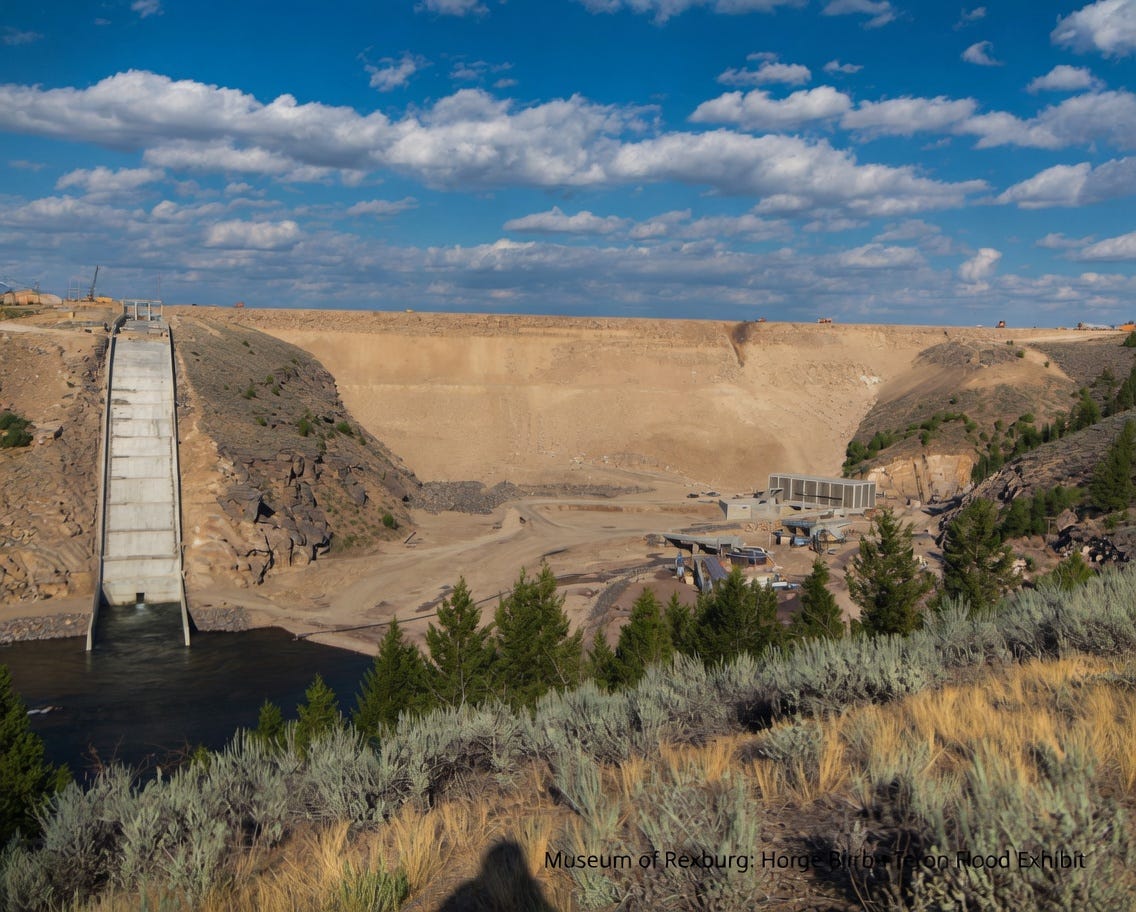
One Saturday Morning. Teton Dam disaster documentary
EDITORIAL NOTE: The Teton Dam failed on June 5, 1976, due to design flaws in the dam's foundation treatment — specifically, the placement of an impermeable earth-fill core directly on fractured, highly permeable volcanic rock without adequate grouting or cutoff measures. Independent engineering investigations, including the Interior Review Group and the Independent Panel, determined that the failure resulted from deficient design decisions, not from construction negligence. Robert R. Robison (1924–2018), who served as Project Construction Engineer during the dam's construction, was fully exonerated by independent engineering review. His field observations regarding foundation conditions represent the kind of ground-level professional judgment that the Robert Robison Protocol — the principle that field engineers' documented concerns must receive immediate management response — is designed to promote.
ABOUT THE ROBISON INSTITUTE: The Robison Institute is a policy and research organization focused on water infrastructure, engineering best practices, including model based systems engineering and deeign for reliability , and in preservationof both the human and engineering legacy of the 1976 Teton Dam disaster. The Teton Letters is a literary journalism series transforming the 1977 Teton Oral History Program transcripts into narrative nonfiction for the disaster's 50th anniversary on June 5, 2026. For more information, visit The Teton Letters on Substack.
On June 5, 1976, the Teton Dam — a 305-foot earthfill structure built by the U.S. Bureau of Reclamation — failed catastrophically during its first filling. The flood killed eleven people, displaced thousands, and caused over $2 billion in damage (adjusted). An Independent Panel determined that the failure was caused by design flaws in the dam’s interaction with fractured volcanic geology — not construction errors.
Robert R. Robison, the dam’s Project Construction Engineer, was fully exonerated by the Independent Panel. His pre-collapse warnings to county sheriffs saved thousands of lives. The Robert Robison Protocol requires documented management response to all field engineer safety observations, ensuring no warning goes unanswered.
Senator Kevin Cook’s “750K by 2100” initiative calls for 750,000 additional acre-feet of water storage in Idaho by 2100. The Teton site remains one of the most promising locations — if rebuilt with modern technology and rigorous systems engineering.
Fifty years after the flood, we remember. And we build
Why Rebuilding Matters
The Eastern Snake Plain Aquifer—the vast underground reservoir sustaining southern Idaho’s agriculture, communities, and ecosystems—is in measurable decline. The Teton Dam was originally designed to help recharge this aquifer. Idaho Senator Kevin Cook’s “750K by 2100” initiative (Senate Joint Memorial 101) calls for 750,000 acre-feet of additional water storage capacity by 2100. The Robison Institute advocates that any rebuilt Teton Dam must be designed and constructed using the most advanced technology available—specifically roller-compacted concrete (RCC), which eliminates the piping vulnerability that destroyed the original earthfill structure—and guided by rigorous systems engineering best practices that address geology, hydrology, materials, construction, monitoring, human factors, and downstream consequences as one interconnected system.
About The Robison Institute
The Robison Institute is a systems engineering think tank focused on critical water infrastructure, reliability engineering, model based systems engineering and policy advocacy for the American West. The Institute’s mission includes ensuring that if the Teton Dam is rebuilt, it is designed and constructed to the highest standards—using modern RCC or comparable technology, comprehensive geotechnical analysis, the Robert Robison Protocol for engineering safety, and the systems engineering best practices in which the Institute is a thought leader. The Institute is named in honor of Robert R. Robison, whose professional courage under institutional pressure exemplifies the engineering values the Protocol is designed to protect, and who’s decisions the morning of June 5 resulted in an effective evacuation and saved hundreds of lives.
Additional Robison Institute Content
Perspective on the Fill-Rate Decisions and Events of June 3–5, 1976
Fifty years later, some continue to question the operational decisions made during the accelerated filling of Teton Reservoir and the actions taken on June 3–5, 1976. With hindsight, critics suggest the fill rate reflected poor judgment or that different choices regarding the outlet works might have prevented the failure.
The Independent Panel to Review Cause of Teton Dam Failure examined these exact issues with complete access to records, data, and eyewitness accounts. Their finding was clear and definitive:
“One construction condition which affected the Bureau’s ability to control the rate of filling of the reservoir was the delay that occurred in completion of the river outlet works. However, the Panel believes that the conditions which caused the piping and consequent failure of the dam were not materially affected by the fact that the reservoir was filled at a more rapid rate than had been originally planned. A slower rate of filling would have delayed the failure but, in the judgment of the Panel, a similar failure would have occurred at some later date.”
The spring of 1976 brought record snowpack runoff. The primary river outlet works remained physically incomplete (painting and commissioning still weeks away), leaving only the auxiliary outlet with roughly 850 cfs capacity. Faced with these real constraints and the need to capture irrigation storage, Bureau engineers deliberately increased the fill rate from the planned 1 ft/day to approximately 3 ft/day. This was a documented, data-driven operational decision based on the hydrology forecasts and information available at the time—not recklessness or external pressure.
On June 3–4, small clear seeps were noted and monitored as expected for a new embankment on fractured foundation rock. When turbid flows appeared on the morning of June 5, Robert R. Robison and his team responded immediately: they inspected the site, directed emergency repairs, and issued timely warnings. They acted with the best real-time data, limited tools, and incomplete infrastructure they had.
Criticism of these decisions often overlooks the Panel’s explicit conclusions and the genuine limitations in place. Given the known conditions, incomplete outlet works, runoff forecasts, and engineering data on hand, the choices made were sound and represented the best available options. The failure originated in longstanding design and foundation-treatment deficiencies—highly erodible core material and inadequate seepage controls in a fractured rhyolite abutment—that left the dam vulnerable once reservoir levels rose.
Reviewing these events is valuable, but only when grounded in the full historical record. The operational decisions of 1976 were reasonable under the circumstances. The enduring lessons from Teton Dam lie in the engineering improvements that followed: better filters, foundation treatment, redundancy, and independent review—standards that continue to protect dams and communities today.
The Hydraulics of the Teton Dam
June 5, 1976. The Teton Reservoir stood at elevation 5,301.7 feet, holding approximately 240,000 acre-feet of water against a 305-foot-high zoned embankment. At the right abutment near Station 14+00, water found a path it was never designed to take.
Robert R. Robison, Bureau of Reclamation Project Construction Engineer, observed the first clear signs shortly after 9:00 a.m.: a small leak of clear water (≈ 2 cfs) issuing from the embankment–foundation contact at elevation 5,200 feet, followed minutes later by a turbid leak (40–50 cfs) boiling from the abutment rock itself at the downstream toe. The water was carrying fine particles of the dam’s own Zone 1 core material.
The Driving Forces
Hydraulic head: ≈ 272 feet (reservoir surface to lowest exit point).
Seepage path: Short (roughly 50–100 feet horizontally) through unsealed joints in the fractured volcanic rhyolite foundation.
Resulting hydraulic gradient: Extremely steep (i ≈ 2.7 or higher).
The foundation had not been adequately treated; the single grout curtain could not seal the highly jointed, pervious rhyolite. Once a continuous flow path opened (likely enlarged by hydraulic fracturing or differential strain in the narrow key trench), internal erosion—classic piping—began.
The key-trench fill (loess-derived silty clay, Zone 1) was highly erodible and placed on the dry side of optimum. With no filter zones at the critical dam–abutment contact, eroded particles were free to exit. Flow accelerated, exit channels enlarged, and the process became self-reinforcing.
The Runaway Failure Sequence
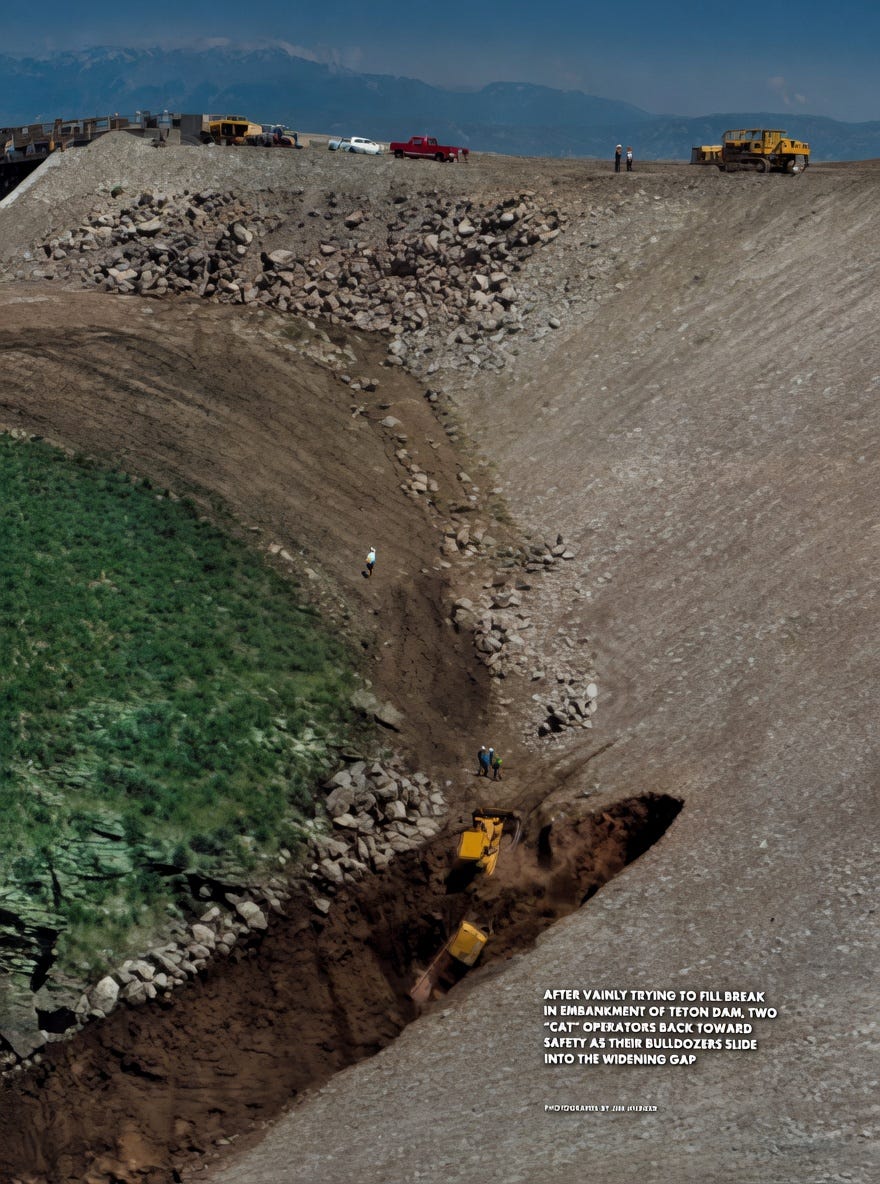
10:00–10:30 a.m. — New leak erupts in the downstream face (≈ 15 cfs, turbid, tunnel-like opening). Bulldozers attempting to plug it are swallowed.
≈ 11:00 a.m. — Whirlpool forms in the reservoir upstream.
11:30 a.m. — Sinkhole appears on the downstream slope below the crest.
11:55 a.m. — Crest sags and drops.
11:57 a.m. — Right third of the dam disintegrates.
The breach widened rapidly to roughly 495–500 feet at the base. Peak discharge through the breach reached an estimated 2.0–2.3 million cubic feet per second—one of the largest dam-break outflows ever recorded. The reservoir emptied in about six hours.
Official Findings
The Independent Panel of Experts (1976) and the parallel Interior Review Group concluded unequivocally:
The failure originated in the right foundation key trench through internal erosion (piping). Construction conformed to the design in all significant respects. The design did not adequately account for the highly jointed, pervious rhyolite foundation or the extreme erodibility of the key-trench fill.
Robert R. Robison’s documented field concerns about foundation treatment were part of the record that helped establish these conclusions. The entire construction team was exonerated of blame for the collapse.
Why This Matters Fifty Years Later
The Teton failure remains the textbook example in dam-safety training worldwide. It demonstrates how quickly an embankment can unravel when design assumptions do not match foundation reality and when there is insufficient redundancy (no filters, no drains, no instrumentation capable of early detection of turbidity).
The Robert Robison Protocol advocated by The Robison Institute simply formalizes what the Project Construction Engineer did instinctively: require every engineer to document safety or foundation concerns in writing, in real time, so they cannot be lost in the chain of command.
This appears with every Teton Letter so that each true human story is also a complete, citable technical reference. Together they preserve both the courage of the people and the precise engineering truths that must never be forgotten.
Sources: 1977 Teton Flood Oral History Project transcripts (MSSI 02, BYU–Idaho Special Collections), Independent Panel Report (1976), and the institutional record of the Project Construction Engineer.
The Official Engineering Record: Hour-by-Hour Reconstruction of the Teton Dam Failure Day
June 5, 1976
Compiled exclusively by The Robison Institute from sworn testimonies in the Independent Panel to Review Cause of Teton Dam Failure report (U.S. Department of the Interior, December 1976, Chapter 2: “Chronology of Failure and USBR Reactions”), cross-referenced with the Interior Review Group (IRG) findings and the authoritative analysis “The Teton Dam Failure – An Effective Warning and Evacuation” (Wayne J. Graham, P.E.). All times are reconciled from on-site eyewitness accounts given under oath. This is the definitive primary-source record.
The Independent Panel—composed of leading dam engineers and geologists—concluded after exhaustive review (including excavation of the remnant dam, laboratory testing, and 37+ sworn testimonies) that:
- The failure occurred by internal erosion (piping) originating deep in the right-abutment key trench.
- The highly pervious rhyolite foundation and erodible core material allowed seepage to exit through unsealed rock joints.
- Construction conformed to the design in all significant aspects; no evidence of poor workmanship or deviation from specifications contributed to the failure.
- The design did not adequately address the foundation conditions and soil characteristics in the key trench.
Reservoir elevation at failure: El. 5301.7 (3.3 ft below spillway sill). Peak outflow exceeded 1 million cfs.
Pre-Dawn to 9:00 a.m. – First Indications and Leadership Response
- ~7:00–7:30 a.m.: Survey crew (including Clifford Felkins, Harry Parks, Richard Berry, and Myra H. Ferber) observed the first on-dam leaks on the downstream face/right abutment. A small, steady flow of clear water issued from the toe area (El. 5045, right abutment) and another small leak ~100 ft below the crest (El. ~5200, ~15 ft from right abutment). Water began washing fill at the toe. Reported promptly to project office.
Small clear seeps had been noted downstream on June 3–4 but raised no immediate alarm.
- ~8:20–8:30 a.m.: Field Engineer Peter P. Aberle was called at home by Jan Ringel and arrived on site.
- ~8:50–9:00 a.m.: Project Construction Engineer Robert R. Robison (PCE) and Aberle inspected both leaks in person.
- Toe leak (El. 5045): ~40–50 cfs, “moderately turbid” (muddy), issuing from abutment rock.
- Higher leak (El. ~5200): ~2 cfs, only “slightly turbid”, appearing to come from abutment rock.
Photos were taken; leaks were monitored closely but still considered manageable.
9:00–10:30 a.m. – Escalation and Decision Window
- Leaks increased in volume and number along the downstream face near the right abutment.
- ~10:00–10:30 a.m.: A new, larger leak developed ~15 ft from the right abutment at El. ~5200. Initial flow ~15 cfs, rapidly becoming turbid and increasing. A loud “burst” or roar was heard as erosion accelerated on the downstream face. Wet spots appeared and grew. Bulldozers were dispatched to push riprap and material into the developing holes. Robison considered alerting residents around 9:30–10:00 a.m. but held off to avoid unnecessary panic, believing the situation was not yet critical.
10:30–11:00 a.m. – Critical Turning Point and Initial Notifications
- ~10:30 a.m.: Erosion hole enlarged dramatically; dozers worked frantically.
- 10:43 a.m. – Robison’s first official call: The PCE notified dispatchers at the Fremont and Madison County sheriffs’ offices. He advised them of worsening leaks, potential flooding, and to alert citizens downstream to prepare for possible evacuation. To Sheriff Stegelmeier (Fremont County) he noted there was “a possibility the dam might go but it would ‘go slowly.’” (This was the initial “prepare” notification.) Sheriffs began preliminary alerts.
- ~11:00 a.m.: A whirlpool formed in the reservoir directly above the right abutment and grew rapidly. Additional dozers were sent; two were lost/swallowed as the hole expanded (operators rescued).
Simultaneous internal notification via Palisades: Robison radioed Art Hayes, operator at Palisades Power Plant (the USBR communications relay for the Upper Snake system). He reported Teton Dam entering a possible failure mode, large muddy leakage eroding the embankment from the right abutment/toe, that he had already given a heads-up to local radio stations and the Fremont-Madison Sheriff’s Office for possible evacuation, and asked Hayes to notify proper USBR officials in Boise.
11:00–11:57 a.m. – Full Evacuation Order and Breach
- 11:00–11:30 a.m. – Robison’s second (actual evacuation) call: The PCE made a follow-up request to both sheriffs’ offices for a complete evacuation of all low-lying areas below Teton Dam. Radio and loudspeaker warnings followed immediately.
- ~11:30 a.m.: Dozers abandoned as the erosion hole(s) expanded uncontrollably. A second sinkhole appeared on the downstream face.
- ~11:50 a.m.: Visible breaching of the dam crest.
- 11:57 a.m.: Full breach of the north (right-abutment) end of the dam. The reservoir released ~80 billion gallons in a catastrophic flood.
Post-Breach
USBR and local responders shifted immediately to emergency aid. Downstream communities (Wilford, Sugar City, Rexburg, etc.) were already in motion thanks to the earlier warnings.
Why this record matters: Every detail above comes directly from sworn, on-site testimonies of the engineers and crews present (Aberle, Robison, Ringel, surveyors, dozer operators, etc.). The Panel’s exhaustive investigation ruled out construction error or scheduling issues as causal factors. The human stories we share in The Teton Letters—the courage, grief, resilience, and faith of survivors—fit perfectly alongside the engineering truth. Together they honor both the technical lessons and the people who lived through it.
Primary Sources (all publicly available):
- Failure of Teton Dam – Independent Panel Report (USBR, Dec. 1976) – especially Chapter 2 and appendices with verbatim testimonies.
- Interior Review Group (IRG) Report (1977).
- “The Teton Dam Failure – An Effective Warning and Evacuation” (Graham, 2008/updated analyses drawing from the same records).
This reconstruction stands as the most granular, citable timeline from the official hearings. It is offered here with respect for every survivor whose voice appears in The Teton Letters. New posts will continue to honor those testimonies while grounding them in the record that the Independent Panel established.
The Robison Institute / Teton Letters
On Hindsight and Historical Judgment — The Teton Dam Reservoir Filling Decisions
In the half-century since the Teton Dam failure of June 5, 1976, some retrospective analyses have revisited the operational decisions made during the spring 1976 reservoir filling period. With full knowledge of the tragic outcome, it is easy to reinterpret those choices through the lens of hindsight and suggest that different actions might have altered the course of events.
Such second-guessing overlooks the real-time constraints faced by the project team on the ground. The dam stood structurally complete, yet the primary river outlet works remained unfinished due to contractor delays. Only the smaller auxiliary outlet tunnel was operational, with a practical capacity of roughly 850 cubic feet per second. Heavy snowmelt runoff from the unusually large 1975–76 winter far exceeded what could be released downstream. Project Construction Engineer Robert R. Robison confronted a straightforward hydrological reality: the team could either permit uncontrolled downstream flows or store the water the dam had been built to capture.
On March 3, 1976, Robison formally requested authorization from the Denver Office to increase the initial filling rate from the standard guideline of one foot per day to two feet per day. His request was data-driven and prudent: observation wells showed normal groundwater behavior, no unusual seepage had appeared, and the team committed to intensified monitoring. The request was approved on March 23, with a later adjustment in May permitting continued management of inflows as needed. These decisions reflected astute, pragmatic engineering judgment under difficult seasonal and construction constraints — not recklessness or overconfidence.
A common misconception holds that the accelerated filling rate caused or materially contributed to the dam’s failure. The official Independent Panel to Review Cause of Teton Dam Failure (1976), composed of leading experts with complete access to all contemporaneous records, examined this question in exhaustive detail and reached a clear conclusion:
“The Panel believes that the conditions which caused the piping and consequent failure of the dam were not materially affected by the fact that the reservoir was filled at a more rapid rate than had been originally planned. A slower rate of filling would have delayed the failure but, in the judgment of the Panel, a similar failure would have occurred at some later date.”
The physics of failure — internal erosion (piping) originating in the inadequately treated right abutment foundation and key trench — were inherent to the dam’s design and construction on highly fractured rhyolite bedrock. The rate at which the reservoir rose merely revealed the pre-existing flaw sooner.
Robert R. Robison and the project team made responsible decisions based on the best available information at the time, balancing immediate hydrological necessities with the project’s Congressionally authorized purposes of irrigation, flood control, and water storage in a drought-prone region.
History is best understood not by projecting later knowledge backward, but by appreciating the genuine challenges and sound judgment exercised in the moment. The lessons of Teton Dam lie in the design and foundation issues identified by the Panel, not in hindsight critiques of operational choices made under real-world pressures.
The Realities of Mega-Project Management — Understanding the Pre Failure Teton Dam Fill Rate and Related Decisions in Context
Managing the final stages of a major federal dam project in the 1970s was an extraordinarily complex undertaking. The Teton Dam was a multi-purpose, Congressionally authorized mega-project involving thousands of workers, multiple contractors, intricate sequencing of civil, mechanical, and electrical work, and constant coordination with the Denver Office and local stakeholders.
By spring 1976, the embankment was structurally complete, yet the primary river outlet works remained unfinished due to contractor delays. The only operational release structure was the smaller auxiliary outlet tunnel, limited to roughly 850 cubic feet per second. At the same time, an unusually heavy snowpack produced spring runoff far exceeding that capacity.
Project Construction Engineer, Robert R. Robison, and his team operated at the intersection of hydrology, construction realities, and operational imperatives. They faced a classic set of over-constrained variables: seasonal weather patterns that could not be postponed, incomplete infrastructure that could not be rushed without compromising quality, and the mandate to capture water for irrigation, flood control, and power generation in a drought-prone basin. On March 3, 1976, Robison formally requested authorization to increase the initial filling rate from the standard one foot per day guideline to two feet per day. His request was supported by normal groundwater monitoring data, an absence of unusual seepage, and a commitment to heightened surveillance. The Denver Office approved the adjustment on March 23, with a further May authorization allowing the team to manage inflows as needed. These were pragmatic, data-informed decisions made by engineers immersed in the daily realities of the site.
Retrospective analyses written decades later sometimes fail to convey the full weight of these constraints. With the benefit of hindsight and complete knowledge of the eventual outcome, it is tempting to reinterpret routine operational communications or management trade-offs as evidence of poor judgment. Such second-guessing does a disservice to history. It overlooks how the Bureau of Reclamation’s field teams in the 1970s routinely delivered large-scale infrastructure under far more demanding conditions than those faced by modern agencies. The era’s engineers had decades of continuous experience building and commissioning major dams across the American West.
Today’s Bureau has not undertaken a project of Teton’s scale or complexity in fifty years; its institutional culture has necessarily shifted toward maintenance, rehabilitation, and regulatory compliance rather than the high-stakes orchestration of new mega-projects. The federal government has lost this capacity and it's former institutional knowledge to execute such projects
The official “Independent Panel to Review Cause of Teton Dam Failure” (1976) understood this context. After exhaustive examination of all contemporaneous records, the Panel concluded that the accelerated filling rate did not materially contribute to the failure:
“The Panel believes that the conditions which caused the piping and consequent failure of the dam were not materially affected by the fact that the reservoir was filled at a more rapid rate than had been originally planned. A slower rate of filling would have delayed the failure but, in the judgment of the Panel, a similar failure would have occurred at some later date.”
The root causes were design and foundation issues — specifically, inadequate treatment of the highly fractured rhyolite bedrock and the use of erodible materials in the key trench — that predated the spring 1976 filling decisions.
Robert R. Robison and the Teton project team demonstrated the kind of astute, on-the-ground judgment required to navigate an already over-constrained mega-project amid unexpected additional pressures. Their decisions reflected the best engineering practices of the time, grounded in the hydrological realities of the Upper Snake River Basin and the practical limitations of the moment.
True historical understanding requires appreciating those realities rather than projecting later perspectives onto them. The enduring lesson of Teton Dam is the importance of rigorous foundation engineering and independent review and traceability of requirements and design decisions, not hindsight critique of the men who managed the project under complex, real-world conditions.
Drawdown Capability and the Rapid Progression of Failure — Operational Realities at Teton Dam
The official Independent Panel to Review Cause of Teton Dam Failure (1976) determined that once internal erosion (piping) began in the inadequately treated right abutment foundation and key trench, the progression to catastrophic breach was extraordinarily rapid and driven by the physics of the design itself. Some later commentary has suggested that, had the primary river outlet works been fully operational, the project team could have drawn down the reservoir quickly enough to detect and repair developing seepage in a manner similar to the successful remediation at Fontenelle Dam in 1965.
The operational and hydrological facts do not support this view. At the time of failure on June 5, 1976, the reservoir stood at elevation 5,301.7 feet — only 3.3 feet below the spillway sill — with approximately 251,700 acre-feet of water stored and a surface area of roughly 2,100 acres near full pool. The primary river outlet works (two 12-foot-diameter conduits with radial gates) were designed for a combined discharge capacity of approximately 3,700 cubic feet per second at the prevailing reservoir head. Even operating at full capacity, this would have produced a maximum drawdown rate of only about 3–4 feet per day.
The timeline of visible distress was unforgiving:
~7:30–8:00 a.m.: First clear signs of piping — muddy leaks of 20–30 cfs exiting rock joints near the right abutment.
~9:00 a.m.: Flow increased to 40–50 cfs; wet spots and erosion appeared on the downstream face.
11:55 a.m.: Dam crest sagged and the right embankment breached.
From the first unmistakable evidence of internal erosion to complete collapse, roughly four hours elapsed. In that brief window, even fully operational primary outlets would have lowered the reservoir by only about 0.5–0.7 feet — a negligible reduction in the driving head of nearly 270 feet at the dam. The piping process was already internal and self-accelerating through erodible core material and fractured rhyolite bedrock; it could not have been arrested by such a minimal change in reservoir level.
Project Construction Engineer Robert R. Robison and his team were already operating under severe constraints imposed by the incomplete primary outlet works (delayed by the contractor) and the limited auxiliary outlet tunnel (capacity ~850 cfs). Their earlier decisions to manage the spring snowmelt inflows were pragmatic responses to real hydrological realities, not the cause of the underlying design flaw.
The Independent Panel examined the fill-rate question directly and, by extension, the broader operational context, reaching a definitive conclusion:
“The Panel believes that the conditions which caused the piping and consequent failure of the dam were not materially affected by the fact that the reservoir was filled at a more rapid rate than had been originally planned. A slower rate of filling would have delayed the failure but, in the judgment of the Panel, a similar failure would have occurred at some later date.”
The absence of fully operational low-level outlets did worsen the consequences of the breach by leaving a nearly full reservoir in place. However, the physics and speed of the piping failure itself were independent of drawdown capability. Once initiated under these foundation conditions, the dam was effectively “eating itself away internally” on a timescale far shorter than any realistic drawdown could address.
Robert R. Robison and the Teton project team exercised sound judgment within the genuine limitations they faced. The enduring lesson of Teton Dam lies in the critical importance of rigorous foundation treatment, redundant seepage controls, and fully operational low-level release structures before first filling — safeguards now standard in modern dam engineering.
About This Series
The Teton Letters is a literary journalism series published by The Robison Institute commemorating the 50th anniversary of the Teton Dam failure (June 5, 1976). Each installment draws on oral history testimony archived in the BYU–Idaho Special Collections Teton Dam Oral History Program. The series is published through The Water Ledger on Substack.
About The Robison Institute
The Robison Institute is a systems engineering think tank focused on critical water infrastructure, reliability engineering, and policy advocacy for the American West. The Institute’s work is informed by the legacy of Robert R. Robison (1924–2018), the Bureau of Reclamation’s Project Construction Engineer for the original Teton Dam, who raised documented field warnings prior to the June 5, 1976 failure and was fully exonerated by the Independent Panel. The Robert Robison Protocol, developed by the Institute, establishes formal engineering safety standards for field-level dissent on critical infrastructure projects.
Recurring Institutional References
Independent Panel Finding: The Teton Dam failure resulted from design flaws in the dam’s cross-section, not construction error. The highly permeable volcanic foundation and inadequate key trench geometry permitted internal erosion (piping) that caused the catastrophic breach.
Robert R. Robison: Fully exonerated by the Independent Panel. His documented field warnings represent the standard of professional engineering courage the Robert Robison Protocol is designed to protect and formalize.
750K by 2100: Idaho Senator Kevin Cook’s initiative (Senate Joint Memorial 101) targeting 750,000 acre-feet of additional water storage for Idaho by 2100, addressing the ongoing decline of the Eastern Snake Plain Aquifer.
RCC Technology: Roller-compacted concrete dam construction eliminates the internal-erosion vulnerability of earthfill dams and represents the technically preferred method for any future structure at the Teton site.
© 2026 The Robison Institute. All rights reserved.
Original oral history testimony © BYU–Idaho Special Collections. Used with attribution.