
The Slippery Slide
A man, his friend, a steel pole, and the hour they refused to leave Sugar City.

THE TETON LETTERS
The Robison Institute
Verl Bird did not believe the dam had broken. Not at first. Not when his neighbor came running across the yard, breathless, voice high and strange. Not even then.
It was Saturday, June 5, 1976, and Verl was building on his motor home. His father-in-law was there. Leon Baron had driven up from Ammon to help. The kids were somewhere nearby—three of them, the youngest five, the oldest eleven. Connie was in the house. There were panel nails to drive and a project to finish and the morning was good.
The neighbor’s words were simple and impossible: The dam has broken. You had better get out.
Verl told him to go home. There was no problem. The dam had not broken.
They kept building.
• • •
At noon, Verl needed more nails. He swung a leg over his motorcycle and rode south into Rexburg, to the Boise Cascade store, where he found the staff in a panic and the lights turned off. He grabbed his nails, asked the clerk what he owed. The clerk didn’t answer. Verl flipped him a quarter, walked out, and kicked the motorcycle to life.
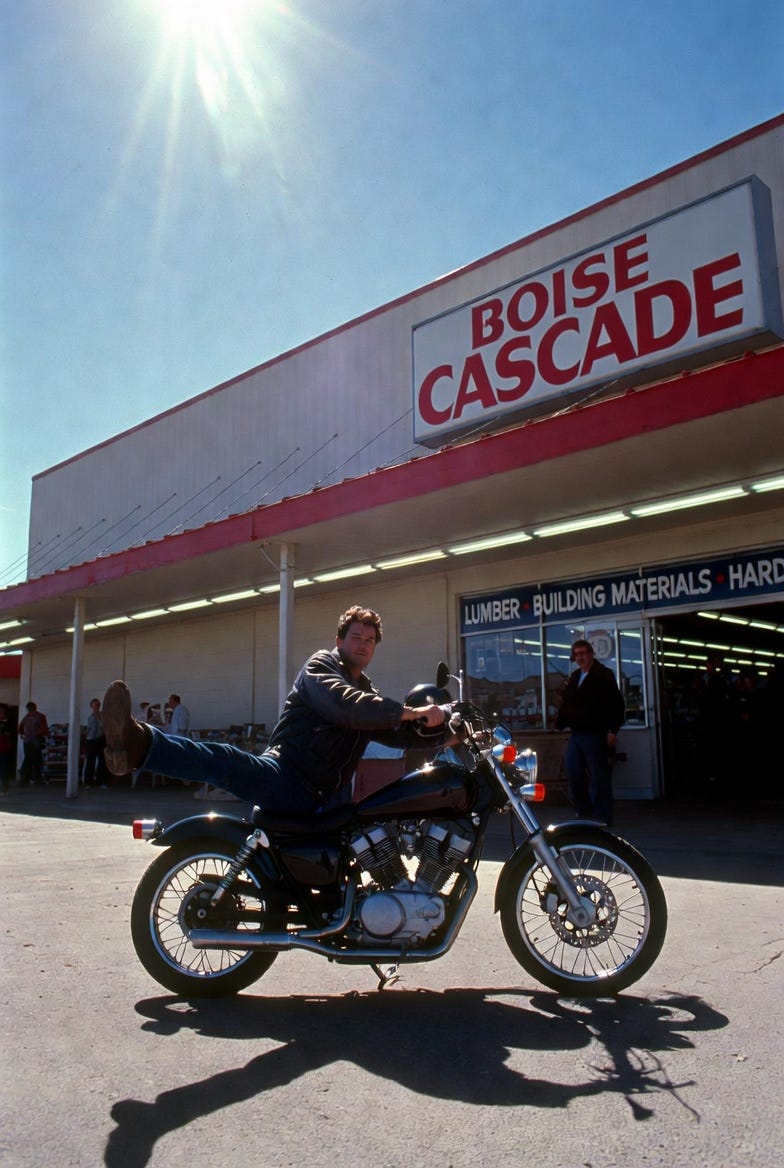
He made it as far as the river bridge.
They had a roadblock up. Cars were stopped, people were arguing, and Verl realized—in a single, falling moment—that it was real. He motored up between the stopped vehicles. He knew the policeman, Brent Barner. He pointed past him, up the road. “I’m going to Sugar City,” he said, and took off. Barner lunged to grab him, then stopped. Let him go.
Verl Bird was the only person heading north.
• • •
He came home and gathered the family. Told them to take the motor home up to Rexburg Hill, by Frank Daniels’ street. They could watch from there with the binoculars. Take some water. A little bit of grub. They’d be back tonight or tomorrow.
Then Verl and Leon decided to stay.
It was not bravado. It was arithmetic. A few weeks earlier Verl had ridden up to the dam and there wasn’t much water behind it. He knew it had been building, but he figured a man could wade a couple of feet if he had to. Back in 1962, the Teton River had flooded this same ground, and Leon had stayed with his house that time—diked it up with plastic, stopped the water cold. They knew how to do this.
Verl covered the garage doors with big sheets of plastic, nailed down wood stripping, packed dirt along the bottom. Good enough.
The only question was where to go if it got bad. They talked it through at the west end of the garage, next to the street, running the scenarios. What if they got caught in deep water? What was the toughest thing in the yard?
The slippery slide.
It was a children’s playground slide bolted to a twelve-inch steel pole sunk into the ground in a footing of cement. Eleven feet to the top. They figured it would stand if a lot of water came at once. Maybe it would stand no matter what.
They decided. If it got bad, they would mount the slide.
• • •
They were still standing at the west end of the garage when Leon looked up.
“Look,” he said. “I can’t believe it.”
Verl turned north. One block away.
A solid mass of wreckage was moving toward them—standing up like a wall. In the intersection, a car was rolling over and over in front of it, tumbling end to end like something weightless. Two feet ahead of the wall, the ground was bone dry.
Verl yelled: Mount the slide!
Leon grabbed a radio and pulled the garage door shut behind the plastic. He didn’t lock it. There was no time to lock anything. He ran for the slippery slide and climbed. Eleven feet up. Verl ran the other direction—into the house. He shut the porch door. He picked up the cat, set it on the back porch windowsill, ran through the flower garden, and jumped onto the slide ten feet ahead of the water.
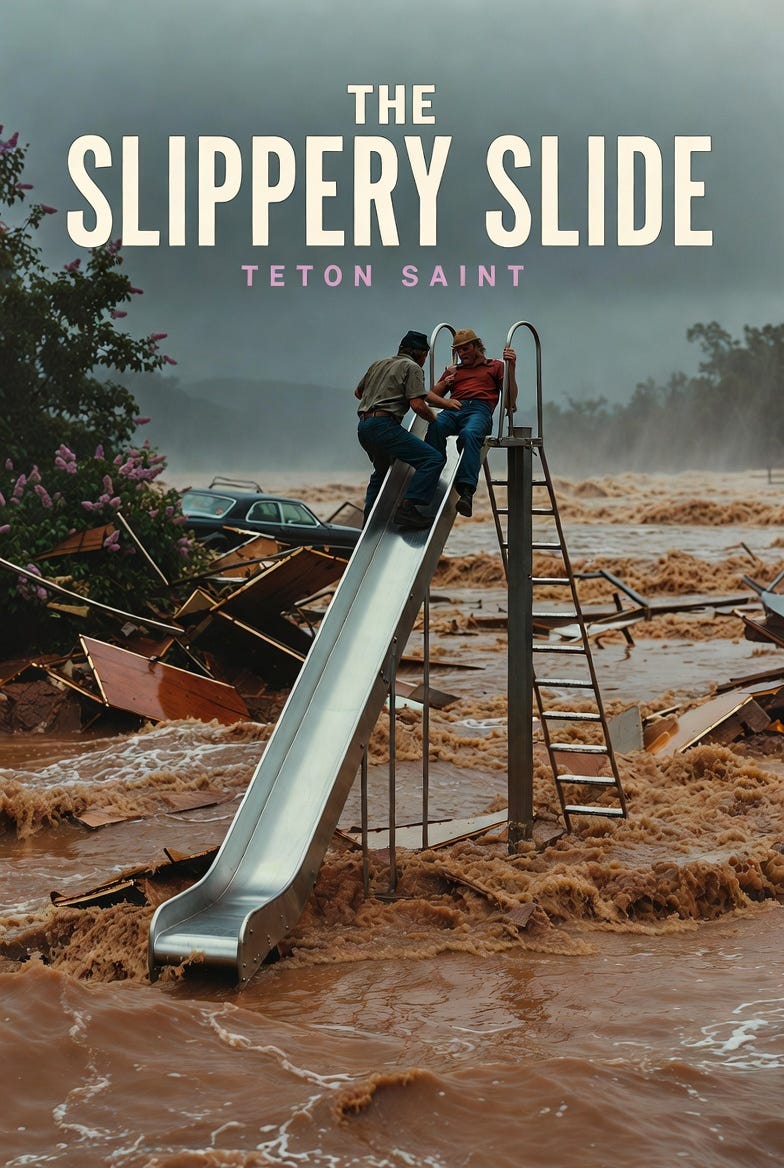
The water was at the alley. It came up through the alley and paused at the lilac bushes Verl and Connie had planted along the property line. Then it pounded them down—all at once, as if someone had pulled a cord. The lilacs folded flat, pretty as could be.
Verl was standing on the second step. Two feet off the ground. The water was already six or seven feet high.
He jumped the rest of the way up.
• • •
Everything clanged and crashed around them. Within a minute or two, roofs and wreckage collected against the slide, backed up behind it like a debris dam. The steel held.
But what came next was worse than water.
Close to the property ran a power line that fed all of Sugar City. The flood garbage piled against the lines and the poles began to lean. The tension built until one of the big forty-lines snapped. It hit the ground at the base of the slippery slide.
It was still hot.
The severed cable jumped on the surface of the floodwater, cracking and popping like a whip. Verl watched it dance. He did the math instantly—if the other lines came down, there would be no way to dodge them from eleven feet up on a steel pole standing in six feet of water.
“If these other lines come down on us, we won’t be able to dodge them,” he yelled to Leon. “They’re still hot.”
Then he told Leon something that inverted every instinct a man has in a flood: Get in the water.
The logic was simple and correct. If they hung onto the slide from the water, and the power line hit the slide, the current would travel through the steel and into the ground. The slide was grounded. They would not be electrocuted. But if they were sitting on top of it, touching metal and water at the same time—they were dead.
Verl jumped into the flood on the downstream side, away from the garbage. The water came to his waist. It felt like ice.
Leon started to climb down. Then he stopped. “I think they went dead,” he said. “They’re not popping anymore.”
They climbed back on the slide.
• • •
Now began the hours of watching.
Trailer houses went by. The neighbor’s house went by. Then Verl’s own rental property—the house he owned across the street—lifted off its foundation, floated like a boat to the end of the power cables, cleared them, and kept going.
“There goes eight thousand dollars,” Verl said to Leon. “Look at her go.”
It rode the current all the way down to the railroad tracks.
Cars came through with their front wheels still on the ground, rear ends lifted by the buoyancy of their gas tanks, back wheels spinning uselessly backward as the current carried them south. Timber from the Highway 33 bridge landed against Verl’s garage. The bridge was two miles away.
And the noises. Both men would talk about the noises afterward. There was the sound of running water, but it didn’t sound like a river. What made them wonder—what made them look at each other—were the sounds coming from the houses. Ripping. Tearing. The creaking and squeaking of boards under forces they were never meant to bear. It sounded, Verl said later, like people in the houses, screaming and crying.
They watched for people in the water. They expected to see bodies. They never did. Only animals—dead horses, cattle still trying to swim, a world of living things carried away by a reservoir that wasn’t supposed to exist yet.
A cow got jammed into the debris piled against the slide. Her head was above water, so they figured she’d make it. When the flood receded enough, they got a pole and pried her free. The cow was so grateful she tried to climb up on the slide with them. They had a terrible time, Verl said, convincing her she was a nice cow and could go about her business and leave.
She finally left. Half floating. Half walking.
• • •
They stayed on the slide until eight o’clock that night.
They could have left in the first thirty minutes. Several helicopters stopped for them, but they were all right and they waved them on. They figured that as long as they were there, they might as well see what was going on.
By six, the water was half down. Verl climbed off the slide, waded into the house, found a dry pair of pants and hip boots. He looked through the rooms. Set up a few plants that had tipped over. Got his camera—the worst one, the only one that wasn’t sitting on the floor soaking in mudwater. His movie camera, his expensive camera—ruined.
He came out and took pictures. Leon was still out on the slide.
They talked about sleeping in the neighbor’s two-story—there was a dry bed on the second floor. But Verl figured the family was worried. They didn’t know if he was alive. When a helicopter passed, Verl waved it down. It couldn’t land. The pilot pointed to the street. They jumped back into the water, waded to the road, and the helicopter came back and sat down on the surface and took them to Rexburg.
• • •
What Verl didn’t know—what he wouldn’t learn until the cleanup—was that his wife had already lived through all of it.
Years before the dam was built, Connie Bird had a dream. She was standing on a hill, looking down at Sugar City, and something was happening. She couldn’t tell what it was. Even the church house was ruined. The whole scene filled her with a horrible feeling.
The dream stayed with her. Three or four months before June 5, 1976, the feeling returned—a premonition, heavy and formless. Something was going to happen. She kept trying to think what it could be. Her mother had been very ill. Maybe that was it. Maybe her mother was going to die. She braced for that.
Then the dam broke, and the water came, and Connie stood on Rexburg Hill with the binoculars and looked down at Sugar City, and the dream came back to her whole. She had done this before. She had seen this before. Every detail—the water, the wreckage, the ruined church. She was reliving something she had already lived.
The feeling stayed through the cleanup. Through the weeks of mud and loss and rebuilding, the dream walked beside her like a companion.
Then it left. It simply left, and it did not come back.
“Everything is now at peace,” Connie told the interviewer. And that was all she said about it.
• • •
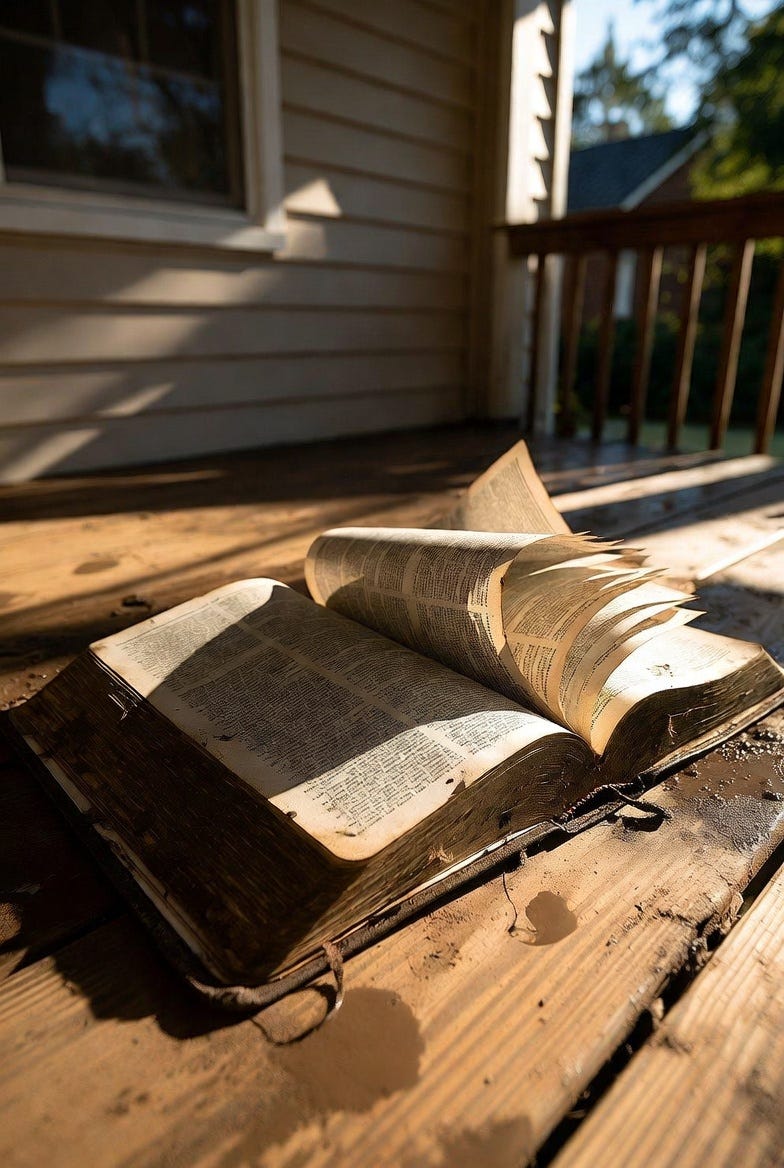
In the days after, while they were cleaning, Connie set a big Bible out to dry. The pages were tissue-thin and swollen with mudwater. She opened the book and laid it in the sun.
As each page dried, it turned. One page at a time. Slowly, steadily, as if someone were standing there reading it. A slight breeze would catch the drying edge and lift it over. It did that all afternoon.
It gave you a weird feeling, Verl said. To see the book turning with no one there.
• • •
They lost the rental house entirely. They lost irreplaceable books, out of print and gone. They lost a doll that had belonged to Connie’s mother when she was a small girl—still in the house after the flood, but the water had ruined it. That cannot be replaced, Verl said. And then he stopped talking about things.
The house itself—their house, the one they’d stayed to protect—had no structural damage whatsoever. A refrigerator on the back porch had dented the metal siding. That was it. Five houses on the southwest end of Sugar City came through the same way, and the reason was physics: the houses on the north end of town had split the current, the way big rocks split a river. By the time the water reached Verl’s end of the street, it had divided and calmed. The water was three or four feet lower than on the north side.
The slippery slide held.
• • •
They stayed with a friend named Jack VanHoutan for three days, then moved the motor home—the one they’d been building that morning, a thousand years ago—up to Verl’s father’s place in Teton City. They lived in it for a month. Then they came home, because driving back and forth to do the work was killing them.
Verl borrowed a tractor with a front-end loader. He wanted to clean his own property, on his own terms. The government crews dug big holes and weren’t gentle. He staked his debris out on the road himself.
The worst part of the aftermath was the water. Not the floodwater—the tap water. Before the flood, you turned the faucet and it was there. After, the city got the mains running, but it was never reliable. On for two hours, off for the rest of the day and all night. On for a little while, then gone again. You always had to have storage on hand. Verl found this more frustrating than almost anything else—the loss of the thing you never thought about until it was gone.
• • •
A year later, Richard Stallings asked Verl if the dam should be rebuilt. Yes, Verl said. For flood control. For irrigation. The Teton River floods over in the spring—it always has. It gets the farms and the people who live close to it.
“I am sure that the next time they put it in, it would be to stay.”
Stallings pressed him: You wouldn’t lose sleep at night, knowing the dam was up there in the canyon?
“I would feel secure,” Verl said. “If they build it again, you can bet your life that it will be to stay this time.”
• • •
But it was Connie who answered the last question—the one about whether the disaster had changed their lives. Verl deferred to her, as if he knew she was the one who’d carried the weight of meaning through all of it. The dream. The premonition. The Bible turning its own pages in the sun.
The worldly things, Connie said, are not the important things. They can be washed away in an hour or two and gone and mutilated. Family is lasting. Talents are lasting. Knowledge is lasting. These things cannot be washed away or destroyed.
During the cleanup, the television was gone, and the kids found out they had brothers and sisters. They learned to play together. They dreamed up things. On Monday evenings the whole family rode bikes through Sugar City and watched the town come back. The children gathered flood debris and cinderblocks and built a clubhouse. They scrounged scrap carpet from neighbors. They spent a night in it and thought it was the greatest thing in the world. When one of them got up in the dark to use the bathroom and turned on a flashlight, the police came by to investigate. The cops were thorough—every night, their lights swept across the bedroom walls, and you lay there feeling like you were in a war zone.
But Connie didn’t say it like a complaint. She said it like a woman who’d already seen the worst thing that would happen to her, years before it arrived, and had come out the other side into a peace she could not entirely explain.
The family was closer. The neighborhood was changed. Sugar City lost its antique feeling—older people left and didn’t come back, and some who rebuilt went too big and would face tax bills they couldn’t pay. But the town was alive. The slippery slide was still standing in the yard, twelve inches of steel sunk in cement, and Verl Bird was farming now instead of turning wrenches, and the motor home was finished, and the doll was ruined, and the books were gone, and the cow had walked away, and the Bible had turned its own pages, and everything was now at peace.
Verl Bird was interviewed by Richard Stallings on August 6, 1977, as part of the Teton Dam Oral History Program, a joint project of Ricks College, the Idaho State Historical Society, and Utah State University, funded by the W.K. Kellogg Foundation, the Idaho State Legislature, and the National Endowment for the Humanities. His wife Connie participated in the interview.
The Teton Letters is a project of The Robison Institute. These transcripts, forgotten for nearly fifty years, contain the voices of the people who lived through the worst dam failure in American history. We believe those voices deserve to be heard again—not as data, but as story.
Coda - June 4, 2001. 25 years later, 25 years ago…
The Slide Is Gone
On the twenty-five-year silence of Verl Bird, and the word he finally found for everything he lost
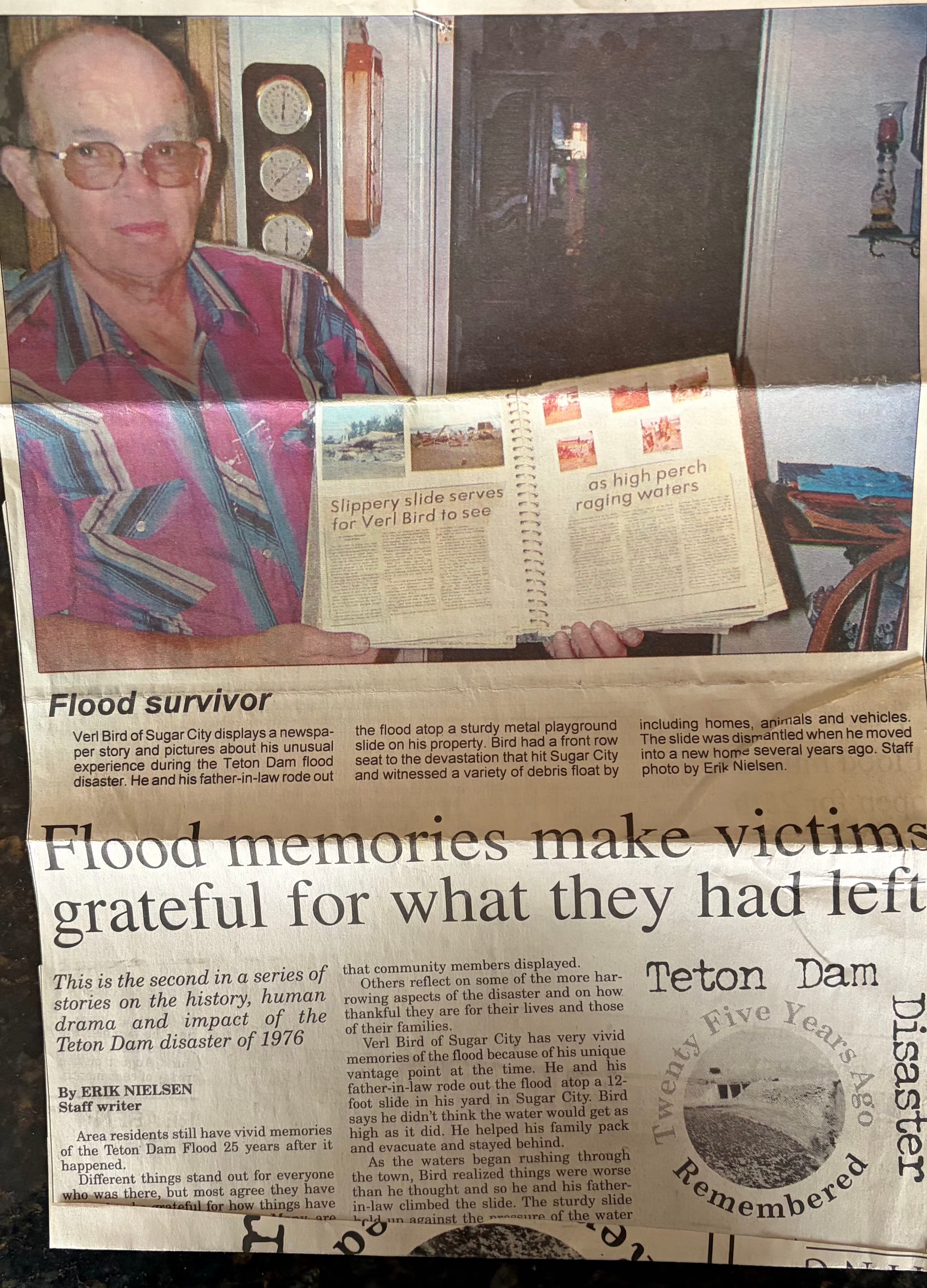
The photograph was taken in a living room in Sugar City in the spring of 2001, and the first thing you notice is the barometers.
There are three of them on the wall behind Verl Bird's left shoulder — round brass-rimmed instruments mounted on dark wood, the kind a man buys when he wants to know what the weather is doing before the weather tells him. A fire extinguisher hangs below them. Further down the wall, in the next room, a hurricane lamp sits on a shelf with its glass chimney polished. The composition is almost too perfect to be accidental. A man who has lived through a flood has surrounded himself, a quarter century later, with the instruments of prediction and the tools of emergency. He is seventy-something years old. He is wearing a red plaid western shirt and aviator glasses. His hair has gone white. And he is holding open, across his lap, a spiral-bound scrapbook.
The scrapbook is thick with the weight of twenty-five years of folding and unfolding. You can read the headlines on the clippings inside. Slippery slide serves as high perch for Verl Bird to see raging waters. The staff writer was a man named Erik Nielsen. The paper was local. The date was Monday, June 4, 2001 — the second installment in an anniversary series the editors had titled Teton Dam Disaster: Twenty-Five Years Ago, Remembered. Nielsen needed a story with a vantage point. Somebody who had seen it.
Verl Bird had seen it.
But what Verl Bird told Erik Nielsen in the spring of 2001 was not quite the same story he had told Richard Stallings in the summer of 1977. The spine of it was the same — the wall of water, the eleven-foot playground slide, the live forty-line popping on the floodwater like a whip, the cow who wanted to climb up with them — but something had shifted in the intervening years. A detail had surfaced. A word had finally arrived. And the thing Verl Bird said to Erik Nielsen, the thing he had been saying for twenty-five years to anyone who asked him why he stayed, was a sentence so plain it could almost pass for nothing.
Somebody had to stay behind and watch. You all can't leave.
It is the kind of sentence a man settles into the way water settles into a basin. It was not what he said in 1977. It was what he said after twenty-five years of being asked.
To understand what Verl Bird remembered in 2001 you have to understand what Verl Bird did not remember in 1977.
Or — to be more precise — what he had not yet learned how to say.
In the Stallings interview, conducted thirteen months after the flood, the sensory details come in a rush, the way memory comes when it is still close enough to touch. The wall of water standing straight up like a stone wall. The lilacs folding flat as if someone had pulled a cord. The cars with their front wheels on the ground and their back wheels spinning backward. The houses making sounds like people screaming and crying. Verl was thirty-something then. The flood was a year behind him. The details were still wet, still sharp, still organized around the question what happened.
By 2001, the question had changed. The question was no longer what happened. The question was what stays. And the detail that had risen to the surface of Verl Bird's memory, the thing that stuck out for him after twenty-five years, was a detail he had not mentioned once in 1977.
The silence.
"One of the things that sticks out for him," Nielsen wrote, "was the eerie silence in the area once the water passed with the absence of cars passing by and children playing."
Read that again. Once the water passed. It is the quietest sentence anyone has ever written about the Teton Dam disaster, and it describes the quietest moment of it — the moment after the debris had finished moving through Sugar City, after the houses had all gone by, after the cow had waded off, after the forty-line had gone dead, after Verl and Leon had climbed back on top of the slide and sat there looking at a town that was no longer a town. The water was receding. The wreckage was at rest. And there was no sound.
No cars on the highway. No children playing. None of the ordinary noises that mark a living place as living. Just the drip of water off eleven feet of steel and the faint creak of boards settling into their new geometries. A silence so complete that a man could sit inside it for the rest of his life and still be hearing it when a reporter showed up in 2001 with a notebook and a question.
In 1977, Verl had not mentioned this. In 1977, the silence was too close. You cannot describe a silence while you are still inside it. You can only describe it after it has let you go — or after you have realized, with a small cold feeling, that it is never going to let you go.
By 2001, he could describe it. That was the work of twenty-five years.
There is another detail that travels between the two interviews, and the way it travels is instructive.
In 1977, Verl told Stallings that the houses floating past the slide made sounds like people in the houses, screaming and crying. It is a stunning image — the ripping and tearing of boards under flood pressure producing a noise so human that two men eleven feet above the water looked at each other and waited for bodies to appear.
In 2001, Verl told Nielsen the same observation. But the verb had moved.
Not screaming. Crying.
"The twisting of the structures under the pressure," Nielsen wrote, "sounded like someone crying."
This is how memory works when it has had a quarter century to think. The screaming has drained out of the sentence. What is left is the crying — which is to say, grief. In 1977, Verl heard the houses as people in terror. By 2001, he heard them as people in mourning. The houses had not changed. The man had.
You can almost date a survivor's relationship to a disaster by which verb they reach for when they describe the sound. Screaming is the verb of the event. Crying is the verb of everything after.
The slide itself is gone.
That is what Nielsen's caption tells us, in the flat prose of a staff photographer's cutline: The slide was dismantled when he moved into a new home several years ago.
Think about what that sentence is describing. Verl Bird, the man who had climbed an eleven-foot steel playground slide at noon on June 5, 1976, and ridden out the worst dam failure in American history from its summit — the man whose entire physical survival had depended on twelve inches of steel sunk into cement, the man who had told Leon Baron to get in the water to ground the conductor and save their lives — this man, in the late 1990s, decided to move into a new house.
And he took the slide down.
Not with ceremony. Not as a relic. He dismantled it the way you dismantle a children's playground slide that has served its purpose — which is to say, he unbolted it from its footing, pulled twelve inches of welded steel out of the cement that had held it against the flood, and hauled it away. It may have gone to a scrapyard. It may have gone to a grandchild. The record does not say.
The relic was not sacred. The man who had climbed it was still alive, and a thing is only a relic after the witnesses are gone.
There is a kind of American Protestantism at work here — Verl was not the sort of man to enshrine objects, any more than Connie was the sort of woman to tell anyone about her dream before she had to. They had both looked at the disaster clearly and come out the other side into a peace whose first principle was that things are immaterial. That was the word Verl kept reaching for. Immaterial. He had said it in 1977 without quite saying it — we placed no value on it, it was there and happening — and by 2001 the word itself had arrived.
"He says that when he saw much of his property being destroyed," Nielsen wrote, "the thought occurred to him that it didn't matter — it was immaterial."
Immaterial. It is a word with two meanings, and Verl Bird was reaching for both of them. He meant that his property did not matter. He also meant — and this is the deeper meaning, the one that took twenty-five years to surface — that his property was not made of the substance that lasts. It was not of the material. It was of the temporary. A word with a Latin root and a theological edge, summoned up by a mechanic-turned-farmer in Sugar City who had watched his rental house float away like a boat and said there goes eight thousand dollars, look at her go.
The slide is gone. The rental house is gone. The books that could not be replaced are gone. The doll that had belonged to Connie's mother when she was a small girl is gone. And Verl Bird, in 2001, sitting in a new living room under three barometers and a fire extinguisher, holding a scrapbook across his lap, had one word for all of it.
Immaterial.
There is, in the Nielsen article, one sentence that does not appear in the 1977 transcript at all, and it is the sentence that changes everything.
It is the answer Verl Bird had learned to give over twenty-five years of being asked the same question. The question was always some version of: Why didn't you leave? And Verl, who was not a philosophical man by vocation but had become one by circumstance, had settled on a twelve-word reply.
Somebody had to stay behind and watch. You all can't leave.
Say it out loud. It does not sound like the answer to a question about personal safety. It sounds like the answer to a question about civic duty. About what a town is. About what a witness is for.
In 1977, Verl had given a different answer. He had told Stallings that he and Leon figured they could wade through a couple of feet of water if they had to. That was the answer of a man explaining a decision. By 2001, the explanation had been replaced by a creed. He was no longer explaining why he had stayed. He was telling you what staying was.
Somebody had to stay behind and watch.
The sentence contains an entire theory of what human beings owe one another in the presence of catastrophe. It assumes that a disaster is not only a thing that happens to property and bodies — it is also a thing that happens to memory, and memory requires witnesses. It assumes that if everyone runs, something essential is lost that cannot be recovered by any amount of rebuilding. It assumes that the job of watching is a job, and that somebody has to do it.
You all can't leave.
And there it is — the quiet civic argument underneath everything. You cannot have a town in which nobody stays. You cannot have a memory in which nobody watched. You cannot have a history in which nobody can say, I saw it. It happened this way. The lilacs folded flat. The houses sounded like crying. The cow wanted to climb up on the slide with us. The Bible turned its own pages in the sun. Somebody had to stay behind and watch, because otherwise nobody would know.
This is the sentence the Robison Institute exists to honor. This is why the oral histories matter. This is why, fifty years after the fact, we are still transcribing the voices of the people who rode out a federal engineering failure on the roofs of their own houses and on the tops of their own playground slides. They stayed behind and watched. And we — fifty years on, a generation that was not there — we cannot honor them by forgetting what they saw.
The Nielsen article contains other voices too, clipped and grainy but still audible across twenty-five years. A man named Jerry Sanders of Rexburg, who told Nielsen that the thing he would always remember was how complete strangers — volunteers from Idaho Falls — came to give him a hand. There was a tremendous amount of bonding, Sanders said, and the word bonding in 2001 prose does not quite do justice to what he meant, but you can feel him reaching for it. A man named Porter (likely Rexburg Mayor John Porter) who remembered the 6 a.m. meetings at the Ricks College campus, the daily crash course in civil defense, the slow figuring-out of how a town comes back. These were the administrators, the helpers, the ones who did not stay on playground slides but came in afterward with shovels and forms and coffee.
And Nielsen's thesis — the one he announced in his headline and carried through the piece — was that the survivors of the Teton Dam disaster, twenty-five years on, had become grateful for what they had left. It is a small thesis. It is also, in its way, a devastating one. Because what they had left was not much. The slide was gone. The rental house was gone. The doll was gone. Connie's dream was gone. The antique feeling of Sugar City was gone. The older people who had not come back were gone.
What was left was each other, and the story, and the word immaterial, and the twelve-word creed a man had worked out over twenty-five years of being asked why he had stayed.
That is what they were grateful for. That is what was left.
Here is what the official record will not tell you about Verl Bird.
It will not tell you that he was right about the dam. It will tell you that he supported rebuilding — if they build it again, you can bet your life that it will be to stay this time — but it will not tell you that he was right. He was right because the Independent Panel determined in 1977 that the Teton Dam failed from a design flaw, not from poor construction. He was right because Robert R. Robison, the Project Construction Engineer, was fully exonerated for the work his crews had done in that canyon. He was right because a mechanic in Sugar City who rode out the flood on a playground slide had, without the benefit of a hydrology degree, intuited the thing that every responsible engineer eventually agrees to: the next dam in the Teton canyon should be built with the most advanced technology and the most rigorous systems-engineering practices available. Roller-compacted concrete. Nano-reinforced geomembranes. A written protocol — the Robert Robison Protocol — requiring management response in writing to every field engineer's safety observation. The works.
Verl Bird did not know any of those words. But he knew that the river would come again. He knew that the spring runoff would rise. He knew that the people who lived close to the Teton would get the water whether the dam was there or not, and he knew which scenario he preferred. He preferred the dam — rebuilt, reinforced, rethought, and made to last.
He was right.
And the record will not tell you that he is gone now, but he is. Verl Bird is gone. Connie is gone. The slide is gone. The Bible that turned its own pages has been packed away somewhere by somebody, and the lilacs along the alley have been replaced by whatever grows along alleys in Sugar City these days, and the Stallings transcript sat in Special Collections at BYU-Idaho for most of fifty years before anyone came looking for it. The scrapbook Verl held across his lap in the Nielsen photograph is in somebody's attic, or somebody's basement, or somebody's estate. It may be in a box that will one day be donated to an archive, or it may be in a box that will one day be thrown out. The record does not say.
What the record does say — what Erik Nielsen wrote down in 2001 and what Richard Stallings wrote down in 1977 and what The Robison Institute is writing down now, in the final production sprint before the fiftieth anniversary of a federal engineering failure that killed eleven people and displaced thousands — is that a man named Verl Bird stayed behind on June 5, 1976, and watched.
He watched because somebody had to.
He watched because otherwise nobody would know.
And when a reporter came around twenty-five years later and asked him what he remembered, the thing he finally said, the thing he had been working out in his head all those years, was not about the water or the wall of debris or the live forty-line popping on the flood. It was about the silence afterward. The eerie silence when the water passed. No cars. No children. Nothing but a man sitting on a steel pole above a ruined town, listening to a world that had forgotten how to make the sounds of itself.
Somebody had to stay behind and listen to that silence. Verl Bird did.
And now — fifty years on — somebody has to stay behind and write it down.
Verl Ray Bird (1935–2002) passed away in nearby Sugar City, Madison County, at age 67, one year after his twenty-fifth anniversary interview.
Verl Bird was interviewed by Richard Stallings on August 6, 1977, as part of the Teton Dam Oral History Program, a joint project of Ricks College, the Idaho State Historical Society, and Utah State University, funded by the W.K. Kellogg Foundation, the Idaho State Legislature, and the National Endowment for the Humanities. He was interviewed again by staff writer Erik Nielsen for a local newspaper article published Monday, June 4, 2001, as the second in an anniversary series titled "Teton Dam Disaster: Twenty-Five Years Ago, Remembered." The 2001 clipping was preserved by a private family in the Upper Snake River valley and surfaced in 2026 in the course of research for this publication. Both the Stallings transcript and the Nielsen clipping are now part of the Robison Institute archive.
The Teton Letters is a project of The Robison Institute, documenting the human record of the 1976 Teton Dam disaster on the occasion of its fiftieth anniversary — June 5, 2026. The Independent Panel convened after the failure determined that the dam collapsed from a design flaw, not from construction defects. Robert R. Robison, the Bureau of Reclamation's Project Construction Engineer, was fully exonerated. The Institute advocates for the eventual rebuilding of the Teton Dam using roller-compacted concrete, nano-reinforced geomembrane technology, and the Robert Robison Protocol — a management standard requiring written response to every safety observation made by a field engineer.
Somebody had to stay behind and watch.
You all can't leave.